
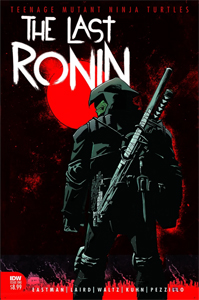
Peter Laird got his “Teenage Mutant Ninja Turtles” stories out of his system in the Aughts, and Kevin Eastman is going through his own phase in the 2020s, starting with “The Last Ronin” five-issue series (2020-22).
Laird never put a bow on Mirage’s future dystopia, being content to leave it as a sporadic collection of hints and shocking far-future revelations. Most of these tales reference rising water levels, particularly bad for NYC.
It’s a pretty cool – albeit downbeat – way to peek into a future that we know is always changing, as Yoda says and as time mistress Renet would agree. However, we never got the complete future-set Mirage arc Laird and Eastman sketched out in 1987. Until 2020. “The Last Ronin” is not on the Mirage timeline, although it is “Mirage-leaning,” as Eastman said.
“The Last Ronin” (2020-22)
IDW, five-issue series (set on the “Last Ronin” timeline)
Writers: Kevin Eastman, Tom Waltz (story and script); Peter Laird (story)
Pencils and inks: Esau Escorza, Isaac Escorza
Colors: Luis Antonio Delgado, Samuel Plata
Though excitement for the project is legit, the narrative might seem familiar to serious fans. Laird dipped into his “Last Ronin” notebook for the 2003 cartoon. It includes an Oroku being so powerful that his Japanese-style headquarters is a prominent NYC building, a disfigured Baxter Stockman, and Fugitoid as a computer and a tracking device. And the ’03 show directly visits its own dark future in “Same as It Never Was.”
1987 cartoon lead writer David Wise is an unsung influencer. The Turtles’ attack on a Foot skyscraper in Season 1 predates “Ronin.” Everyone knows about the robotic Foot soldiers, and the idea of secondary mutations pops up in later seasons. And what is “Shredderville” if not a cartoony version of the iron-fist rule of Oroku Hiroto?
Last Turtle standing
Structure is one of “Ronin’s” strengths. Its clear yet out-of-order narrative taps into the questions that always arise in fan-service legacy sequels. Issue 1 plays as a mystery of “Which Turtle is the Last Ronin?” Here, Eastman and co-writer Tom Waltz do something sneaky-clever.
(SPOILERS FOLLOW ABOUT THE RONIN’S IDENTITY.)
Mirage’s dark futures plant clues about who is the Last Turtle Standing. Donatello runs holographic simulations to remember his brothers, and is later blinded). Raph is one-eyed, feral and on the outs with student Shadow. Leonardo is ancient and contemplative. Michelangelo’s fate is a mystery. Yet he is the Last Ronin.
It couldn’t be otherwise. He’s the one who goes with the flow, but who would take on the burden (on the inside) of his brothers’ and father’s wants and needs, after they are deceased. Mirage’s future stories of the other three are reflective; Mikey’s “Last Ronin” is an urgent tale where we don’t know what he’ll do.

(The main thing that makes this a new timeline: It’s set about 30 years from 2020, whereas E&L’s notes set it about 30 years from 1987, which is now the past. Plenty of other details, like Splinter’s statement that he killed the Shredder, mark this as a new timeline.)
(END OF SPOILERS.)
Life remains at best bittersweet
One of the artists noted that he’s a “Turtle killer,” and when reading “Ronin” I sense it’s not a status he takes lightly. The deaths of main characters, as shown in flashbacks, have impact inasmuch as they happen, but the artists don’t linger. They are respectful or ashamed to be caught watching.
The matter-of-factness gives me the same feeling as Buffy’s friends being killed in the alternate-universe episode “The Wish.” It taps into that wispy Mirage fatalism – although the framing mechanism for a potentially fatally injured Ronin taps into the tear ducts, too.
Despite telling a future-set story with a beginning, middle and end, “Ronin” remains a feeling more than a narrative because the narrative hits familiar beats, from the attack on Foot headquarters to the endless Hamato-vs.-Oroku feud. These five issues are highlighted by character development for the titular Turtle.
But my feeling that I was reading an all-time elite story gradually gave way to recognizing how Eastman (who contributes B&W flashback pages using his beloved duotone technique) and Waltz are remixing old tales. They do it with passion, panache and precision. Yet “The Last Ronin” can’t overcome the gravitational pull of fatalism.
On some Tuesdays, RFMC looks back at a “TMNT” movie, TV show or comic book. Click here to visit our “TMNT” Zone.