
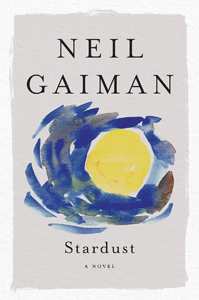
Neil Gaiman makes fantasy fantastic again in “Stardust” (1999), largely because of his prose style. In his introduction to the 2012 edition, he says he imagined himself writing in 1922, before modern fantasy existed. He used a pen and had others type it up.
His style reminds me of late 19th century authors like Doyle and Wells, who write matter-of-factly, with details, without urgency, and in passive voice. They are thoroughly enraptured in their subjects, which were fresh at the time. And artwork is an important compliment, even though in “Stardust” we only get one drawing of the environs (reprinted for each chapter in the 2012 edition) by Charles Vess.
Gaiman’s thirst-for-knowledge vibe matches the love-quest vibe of Tristran (changed to the more pronounceable Tristan for the film adaptation), a young man who doesn’t totally grasp the nature of his love quest. He grows up in the Victorian English village of Wall — so named because it shares a border wall with the magical land of Faerie, where people generally aren’t allowed to go.

“Stardust” (1999)
(DC Comics’ illustrated prose issues of “Stardust” came out in 1997, and the traditional novel version debuted in 1999.)
Author: Neil Gaiman
Illustrator: Charles Vess
Genre: Fantasy
Settings: Victorian England town of Wall and the borderland of Faerie
Note to readers: The Book Club Book Report series features books I’m reading for my book club, Brilliant Bookworms.
A touch of magic in the familiar
As readers, we are a step ahead of Tristran. He is allowed to go because he’s half-human, half-magical-being. He doesn’t know this; we are armed with a prolog whereas Tristran isn’t. Dunstan fathered him with a Faerie woman from the every-nine-years market in the border meadow. Dunstan and his human wife chose to not tell him.
“Stardust” starts slow; you might say it starts twice – first with the Dunstan prolog, then with Tristran. It took me a while, but somehow I found myself into it, and understanding why Gaiman parses out information in this order.
It’s a romance story, told from a side angle, rather than bluntly or analytically. It encompasses different types of love (or false love?), thus making a reader think about what type is the most real. Dunstan’s one-off fling with the Faerie woman is love at first sight to both of them. But then, off-page, Dunstan gets married to a human woman and they happily raise kids and run a farm.
Tristran seeks a fallen shooting star on the other side of the wall to present to Victoria, whose characterization is simply that she’s the most beautiful girl in Wall. (To be fair, Gaiman enriches her later in the book.) Vicky is Tristran’s soulmate from his gauzy teen perspective. We can tell she’s just not that into him, but Tristran is too immature to understand that means he must move on.
When it turns out the star is a living (human-like) being, Yvaine, who is also a beautiful young woman … well, we can see where it’s going. Tristran and Yvaine most definitely can’t, which is rather cute. She hates his guts at first, and with good reason: He keeps her on a chain! But in fantasy, that’s part of the charm – that we know it’s following the Campbellian hero’s journey. That’s why we bought the ticket.
Adult (rather than YA) fantasy
“Stardust” is a bit like “Harry Potter” (indeed, Gaiman’s and Vess’ DC Comics illustrated story began in 1997, the year of “Sorcerer’s Stone,” before being printed as a straight novel in ’99) in that the wide-eyed prose propels us. But Gaiman intends this to be adult fantasy rather than YA fantasy. The way he achieves this is blunt: The prolog includes a sex scene, and later there are moments of violence, and the most extreme violence happens to an innocent animal.
The two villain threads are fairly compelling. In one, an evil witch intends to acquire the star’s heart for the sake of a youth serum. In the other, a trio of brothers – the last survivor of which will be the king of Stormhold – travels to drop their father’s remains at a sacred site, as per required tradition.
It’s amusing how when they die, they immediately live on as a ghost and comment on the exploits of the still-living with all their ghost brothers. Gaiman is hard to translate to film; although 2007’s movie adaptation has plenty of fans, I couldn’t get into it. The ghosts are so whimsical that the life-and-death stakes are undercut, and we can’t avoid the thin characterization of the hero.
In the book, he’s also thinly characterized. Even when a forest witch (not the main baddie) turns Tristran into a dormouse for a chapter or two, we never get Tristran’s POV of the experience! And though Gaiman mentions many magical creatures – even a hippogriff, made more famous by “Harry Potter” – Faerie is not as blow-by-blow magical as Rowling’s world. Yet the groundedness serves Gaiman well, and so does Tristran’s prolonged Everyman status. A blank-slate protagonist can be forgiven in a book more than on screen.
“Stardust” is weird in that I was thoroughly into it by the end but I’m not champing at the bit for more Wall/Faerie yarns. It’s a tidy standalone achievement rather than an explosion of world-building, but its 270-page brevity is charming. Its strength is in Gaiman’s presentation: He somewhat transports me to Faerie, but more successfully, he transports me to the age of cozy fireside storytelling.