
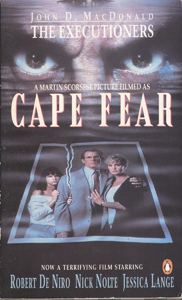
I’ve been reading John D. MacDonald’s Travis McGee series (1964-85), which I absolutely adore, so “The Executioners” (1957) strikes me as a notably more basic novel. I can see why it has been adapted for the screen three times under the title “Cape Fear” – in 1962 and 1991 as movies and this month as a miniseries.
The premise is simple yet infused with tension. When he was younger, family man Sam Bowden turned in a fellow soldier, Max Cady, for raping a 14-year-old girl in an alley in Australia. Cady spent 14 years in prison and is now stalking Sam, intending to “kill him six times” – meaning he’ll kill his dog, his three kids and his wife before getting to Sam.
Weirdly for readers accustomed to MacDonald’s strong sense of a Florida setting in the McGee novels, “The Executioners” takes place in Anywhere, USA. It’s vaguely Midwestern. Talk of Cady being from stock up in hill country makes me think he’s from West Virginia, and therefore the Bowdens could live in North Carolina. It’s definitely not Florida, because we hear regular talk of lakes and no talk of the ocean or swampland.

Not giving “The Executioners” a defined location allows flexibility for when it gets rebranded as a “tie-in novel” (the copy you find will most likely be called “Cape Fear”), but it’s a surprising choice by the author. Giving it any defined location at all would make it more substantial.
On the plus side, another aspect of the McGee novels is present. Even though lawyer Sam is not a first-person narrator, he’s still the POV character, and MacDonald writes thoughtful passages. The book’s core theme is how modern American law isn’t set up to deal with an insane murderer (until after they commit the crime).
Law can handcuff the innocent
In the early days of civilization, the village would get together to kill or exile Cady. In 1957, Sam will get little or no help. At the same time, if he kills Cady in a pre-emptive strike, Sam goes to prison as a murderer.
That’s not to say MacDonald sees law enforcement officers as hapless. The police chief of the city nearest the Bowdens’ farmstead home has walked a fine line, knowing that a crime-free city is impossible and a city run by crime lords is undesirable. So he maintains good relationships with small-time criminals, working with them to keep the mob out. The author also espouses this approach to modern policing in McGee novels such as “The Dreadful Lemon Sky.”

“The Executioners’ ” plot machinations are well thought out. As Sam realizes how trapped he is by the rules of the game, so does the reader. Mostly off-page, Cady is not superhuman, but we see how – to borrow a sports metaphor – he lives rent-free in the heads of Sam and wife Carol. Though children Nancy, Jamie and Bucky (plus dog Marilyn, and also Nancy’s boyfriend Tommy) have strong characterizations, we see them as pawns to be targeted.
MacDonald aggressively maintains a grounded practicality till the end while presenting this situation that most people will never come upon. Even when Sam and Carol define themselves as “executioners” of Cady, it’s natural rather than crazy. I can see how the ending would be surprising in a bad way to some readers. The story is resolved, but some implied threats – such as ominous fact that Nancy is the same age as Cady’s rape victim – remain threats rather than something that gets played out in a scene.
At the time “The Executioners” was published, MacDonald was familiar with Hollywood, seeing seven of his short stories and one novel adapted to the anthology TV thrillers that were popular in the 1950s. I wouldn’t be surprised to learn he had the big screen on his mind when writing this novel. He hits his target; he sold the rights for $30K one year later.
3.5 stars
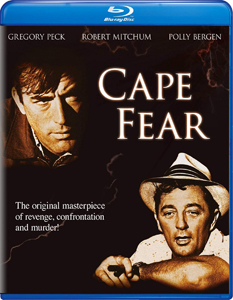
‘Cape Fear’ (1962)
Speaking of the adaptations, the two film versions of “Cape Fear” are snapshots of their times. “Cape Fear” ’62 is a victim of the Hays Code (1934-68). While it’s fun to watch Hitchcock creatively work around the censors, director J. Lee Thompson and writer James R. Webb struggle to figure it out.
The (literally) unspoken theme is rape: It’s why Cady (smolderingly nasty Robert Mitchum) was in prison, and it’s what he plans to do to the wife and teen daughter of lawyer Sam (Gregory Peck). Lori Martin, as Nancy, looks like a small adult, and I wondered if she really was, as a Hays Code adjustment, but she was 15.
“Cape Fear” (1962)
Director: J. Lee Thompson
Writers: James R. Webb (screenplay), John D. MacDonald (novel)
Stars: Gregory Peck, Robert Mitchum, Polly Bergen
As with the novel, the film explores how modern law can handcuff the victims (“Either we have too many laws or not enough.”). But Webb has less faith in the morality of the police than MacDonald does: They actively try to run Cady out of town. The P.I. (Telly Savalas) suggests to the cops a charge of “lewd vagrancy” because Cady picks up a woman at a bar.
“Cape Fear” ’62 is mostly given mood by Bernard Hermann’s score, which is repurposed for “Cape Fear” ’91. The Cape Fear River setting, wherein the Bowdens lay low on a houseboat, plays into the final act; the way Cady climbs onto it reminds me of what MacDonald would later write in “Bright Orange for the Shroud.” One last pulled punch closes the movie: a speech on how rotting in prison is a worse fate than being killed (which, to be fair, it is).
3 stars
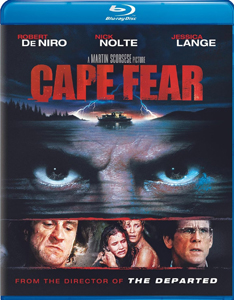
‘Cape Fear’ (1991)
Director Martin Scorsese’s version revels in post-Code freedom while totally respecting the original (including new roles for Mitchum, Peck and Martin Balsam). Wesley Strick sticks to Webb’s structure but – while there’s no nudity and the violence is not gratuitous – this is a colder, crueler film even if it’s more grounded in a warm location (Savannah stands in for North Carolina). Robert De Niro doesn’t go many notches beyond Mitchum, but now Cady unambiguously is a serial rapist; to slick back his hair, he could probably use slime from his own body.
The psychologically destructive aspect of rape soaks into the material now. Illeana Douglas plays the woman whose world is shattered by one night with Cady. And despite avoiding the same fate, the teen daughter (Juliette Lewis, in the role that put her on the map at 18) is robbed of a natural sexual awakening by the blunt force of Cady’s twisted charisma in a centerpiece scene at her school theater.
“Cape Fear” ’91 is one hammer blow after another via close-ups, tilted angles, photographic negatives, expensive action sequences and performances that project to the back row. Strick inserts shocks – two involving Cady’s next-level sneakiness – into the old material.
“Cape Fear” (1991)
Director: Martin Scorsese
Writers: Wesley Strick (screenplay), James R. Webb (1962 screenplay), John D. MacDonald (novel)
Stars: Robert De Niro, Nick Nolte, Jessica Lange
The characters are generally unpleasant; de facto hero Sam (Nick Nolte) is nearly as immoral as Cady, merely secretive about it. The law theme continues, but now Sam – who was Cady’s public defender here – abuses his position. He buried evidence that would’ve reduced Cady’s sentence and now uses his police contacts to harass Cady into leaving town. I hate to admit it, but it’s kind of enjoyable to see Cady outsmart Sam at his own game.
Additionally, Sam is on the outs with his wife (Jessica Lange), and even mom and daughter seem estranged. The movie isn’t so much about a family bonding in an insane situation as it’s about shared trauma; simple survival is a long way from “happily ever after.” Not merely the most off-the-chain version of “The Executioners,” “Cape Fear” ’91 is an immersion into one of MacDonald’s pet themes: the power one human can wield over others by being his truest animal self.
3.5 stars