
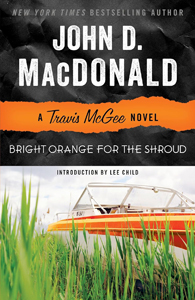
“Bright Orange for the Shroud” (1965), John D. MacDonald’s sixth novel in the Travis McGee series, is an intensely gripping page-turner about the power (psychological, mental, physical) a given human can exert over another given human. The raw primitivism echoes through the evocative setting of the mangrove swamps of the Everglades.
The dangers of one-sided femininity and masculinity
MacDonald illustrates control through a variety of characters, but primarily Arthur, a victim of sex-on-a-stick con-woman Wilma, whose team drains him of his quarter-million dollar savings. The description of the quasi-legal real-estate scheme isn’t exactly easy to follow, but I get the gist, as with “Glengarry Glen Ross.” It’s enough to know this is not an investment Arthur should make.
Later, Arthur – with fellow protagonists McGee and Chookie – must deal with the con team’s muscle, Boone “Boo” Waxwell. (Chookie is the big, sexy dancer introduced in “The Deep Blue Good-by.” Further expanding the size of Travis’ world, MacDonald references many off-page cases here. Perhaps he chooses to not reference chronicled cases due to spoilers.) Boo stands as the male force of nature, a human swamp creature who has no issue with maiming and raping and killing, who is nearly as hairy as a gorilla and who pronounces wire as “wahr.”
“Bright Orange for the Shroud” (1965)
Author: John D. MacDonald
Series: Travis McGee No. 6
Genres: Hardboiled mystery, action
Setting: Everglades, 1965
Via Meyer, who pops in briefly, the author presents an intriguing theory that a person’s empathy comes from a healthy inner balance between masculine and feminine aspects. People become dangerous to others if they are entirely one or the other. They are living weapons, always cocked. Wilma is 100 percent feminine, and Boo is 100 percent masculine.
Chookie flirts with the idea that Boo is what Travis would be in a feral state, but Travis guffaws and Chookie says OK, she has gone too far. That having been said, McGee is the only person who could possibly defeat Boo. His two lovebird teammates can help with intelligence gathering and strategy, but on the whole, this is a job only for the world’s foremost salvage consultant.
“Orange” includes some of MacDonald’s best writing about his adopted state of Florida, with which he has a love-hate relationship. He brings the untamed Everglades to terrifying life, noting that a person could get lost within miles of civilization simply because the islands all look the same.
Shrouded by the Everglades
This is Boo’s territory, so even when MacDonald focuses on Travis, Arthur and Chookie strategizing and having successes, an invisible parallel story lurks behind it: We know the aptly named Boo is still out there. It’s like how horror filmmakers wordlessly wield the possibility of a jump scare.

Amid “Orange’s” theme of taming (or the impossibility of taming) Florida, MacDonald includes a (today politically incorrect) passage about how the Seminoles may be technically unconquered, but in effect have been, partially swallowed up by the land itself.
While I marvel at how MacDonald accurately describes 21st century conditions, “Orange” includes one prediction that intriguingly has not arrived (at least not yet). In chapter 11, MacDonald describes Tampa, a grungy but distinct town that has surrendered its character, then projects into the future:
In some remote year, the historians will record that Twentieth Century America attempted the astonishing blunder of changing its culture to fit automobiles instead of people, putting a skin of concrete and asphalt over millions of acres of arable land, rotting the hearts of their cities, so encouraging the proliferation of murderous, high-speed junk that when finally the invention of the Transporlon rendered the auto obsolete, it took twenty years and half a trillion dollars to obliterate the ugliness of all the years of madness, and rebuild the supercities in a manner to dignify the human instead of his toys.
The “Transporlon” is a rare case in the McGee novels where MacDonald – who dabbled in SF – grasps at a future invention that will solve a modern problem. The other 99 percent of “Bright Orange for the Shroud” is frighteningly grounded in the primitive behavior of selected individual humans.
Sleuthing Sunday reviews the works of Agatha Christie, along with other new and old classics of the mystery genre.