
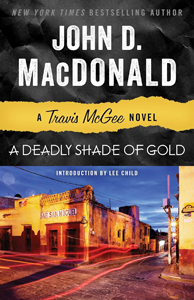
After cranking out the first four Travis McGee novels in 1964 to meet his publisher’s (successful) goal of hooking readers, John D. MacDonald’s fifth entry – “A Deadly Shade of Gold” (1965) – is twice as long, and indeed has epic storytelling heft. We get Travis’ first trip to Mexico and such a deep dive into moral relativity (some of it helped along by Meyer, now in place as his boat-slip bestie) that McGee himself gets the bends.
The only thing it’s missing is a dramatis personae. The most striking character, the villainous international mover-and-shaker Cal Tomberlin, is not introduced until the third act; MacDonald describes him with a deliciously blunt noun: “a grotesque.” A dozen fascinating heroes, villains and stand-bys feature before that, and half of them are romantic interests for McGee. They all matter in the narrative but the sheer volume will make you forget some.
“Gold” is a decent, albeit opaque, novel for exploring how political gamesmanship shapes countries, in this case Cuba. It’s the backdrop to the whole adventure – which starts small, with Travis’ old friend Sam being killed for possessing an ancient gold idol – and I didn’t follow all the ins and outs.

“A Deadly Shade of Gold” (1965)
Author: John D. MacDonald
Series: Travis McGee No. 5
Genres: Hardboiled mystery, action
Setting: 1965; Baja California Sur and Los Angeles
Prime pulp
Still, in chapter 7, MacDonald unleashes a poetic salvo about what was happening to America in the Sixties:
Now the movements of nations have become like a huge slow solemn dance of elephants, random power swaying in unpredictable directions, their movements obscured by a stifling rain of paper, pastel forms in octuplicate, programmed tapes, punch cards. Through this slow rain, in the shadowy patterns of the dance, scurry a half a billion bureaucrats, each squealing self-important orders.
Beneath the wrinkled gray legs, ten thousand generals squat, playing with their war game toys. The billions of mankind sit in the huge gloomy reaches of the stands, staring without comprehension, awaiting the white blast that will char the dancers, end the act. And because tension and waiting can only be sustained so long, they make their own little games and charades in the stands, the charades of art, sex, money, power and random murder.
Among great 20th century art is the field of pulp fiction, and MacDonald provided some of its best art, matching elite literary fiction in many passages. It’s “pulp fiction” because McGee – though not a superhero — is about 10 percent more than an Everyman. In “Gold” he takes physical blows, and MacDonald describes Travis’ experience of getting shot and gradually recovering with efficient snippets. McGee feels like he’s been split in half and glued back together, but both halves seem to work.
In the bigger picture, “Gold” describes a tourist beach in Baja California Sur well, with the lawless lands just beyond the hotel. In the nearby town, it’s like being a new prison inmate; McGee must immediately establish his toughness in order to be left alone.

MacDonald takes a strong moral position about governmental corruption that affects everyone’s lives. Interestingly, he elevates the comparatively inconsequential issue of pornography to that same level. As in the previous book, “The Quick Red Fox,” salacious photos (and filmstrips here) are used as blackmail by the villain, and McGee is as enthused to see that material go up in flames as he is to abscond from a mansion with valuable stone idols.
A golden charade of art
I suppose the anti-porn view fits with MacDonald’s carefully calibrated view of women, wherein every one is a sexual or romantic object, yet at the same time they are more robust characters than the men – even though the top villains in “Gold” are men, and so is McGee’s old friend whose murder initially makes this a revenge tale.
The author finds hope for the human race because compassion, companionship, regret and remorse exist, though not to the degree he wishes. Among the women are Nora, a co-lead for a while whom McGee (by mutual agreement) uses as a shield on his Mexico trip (he’d draw suspicion if he went solo); a whore with a heart of gold at a Mexican brothel; an L.A. party girl who allows him to be off the grid for a while; and a sun bunny who runs with the wrong crowd for the sake of bucks.
If he was alive today, it would be interesting to know if MacDonald would still hold out hope. He did in 1965, noting that America was holding on to a degree of freedom. This made it stand out in comparison to established authoritarian regimes, as well as rebellions that seek to become the new boss, same as the old boss:
That’s why they can never make it. They kill off the good ones. They gut their dreamers. Their drab stone discipline is a celebration of mediocrity. If we can restrain ourselves from killing off our own rebels, our doubters and dreamers, all in the name of making ourselves strong, then we can prevail. But if we use their methods, then any victory will be but the victory of one iron symbol over another, and mankind will have lost the battle no matter which way it goes.
MacDonald’s questions from the mid-20th century are in the process of being answered in the 21st. Whether his fiction still matters is up to each reader, but there’s little question that it serves as diverging (and divergent) art.
Sleuthing Sunday reviews the works of Agatha Christie, along with other new and old classics of the mystery genre.