
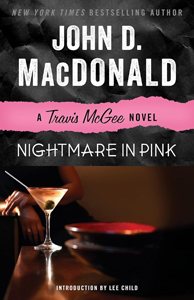
The secret (one I’m not sure we’re supposed to advertise) of John D. MacDonald’s Travis McGee mystery series is that these are actually men’s romance novels. It’s especially true in book two, “Nightmare in Pink” (1964), in which Travis hits it off with Nina, the kid sister of his old war buddy.
Marriage material?
The ailing friend asks Trav to look after New York-based Nina, reeling from the killing of her fiancé in mysterious circumstances. Because it’s a proscribed platonic relationship, we know it won’t stay that way. But it’s earned: MacDonald writes Trav’s and Nina’s bond carefully and convincingly.
So much so that I wonder how MacDonald is going to write his way out of it at the end. He has to, because a mass-market ongoing series requires the same character but mostly eschews characterization. A reader must be able to pick up any McGee book as their first.

“Nightmare in Pink” (1964)
Author: John D. MacDonald
Series: Travis McGee No. 2
Genre: Hardboiled mystery
Setting: New York City, 1964
McGee is a serial bachelor both by structure or by character. Which came first, the chicken or the egg? At any rate, Travis is wired to be unmarried, to take relationships in substantial chunks (in length and depth and memory) but not get hitched. (Like how he earns money in chunks but never retires.) He learns this about himself quicker than does Chandler’s Marlowe (who gets married late in that series) and less brutally than Grafton’s Kinsey (who is twice divorced when that series starts).
Single life is theoretically less tiring, but not in “Nightmare in Pink,” which features three additional well-drawn females beyond fragile-but-determined Nina. Terry is like what we now call a cougar, except the math doesn’t work out; Travis himself is in his late 30s, I think, so Terry must be 50-something. Bonita is high-class so Trav must meticulously navigate social rules to allow her to save face as he rejects her advances. Call girl Rossa is skilled at hiding her emotionlessness, but he notices it in quick peeks. It sounds as exhausting as being James Bond, maybe more so because he’s loyal to Nina.
Oh, there’s also a mystery – a decent one at the start. Nina’s fiancé had $10K in cash hidden in a closet when he was killed, supposedly by muggers. Surely that’s what the killers were after. But what’s the story behind the money?
Cribbing from the master (Spoilers)
(SPOILERS FOLLOW.)
Thematically a story about the challenges of knowing which women to trust, “Nightmare’s” actual nightmare begins with a sudden twist that allows the mystery to build toward answers but also drops the novel’s quality a notch. When a drugged Trav wakes up in a mental hospital, it’s terrifying but also a direct lift from Chandler’s “Farewell, My Lovely” (1940) – slightly freshened for the burgeoning Drug War era.

McGee maintains his toughness and bravery, and kills five people to escape the ward. (A nice touch: McGee clubs a man in the back of the head to knock him unconscious. But this isn’t a movie. The guy dies.) But he does not do anything active to solve the case other than throwing himself into it. The drugging by Rossa is intended to permanently remove him from the picture. One of the evil doctors explains the whole scheme to Travis in the manner of a Bond villain.
He gets out of it simply because a nurse forgets to give him a drug. I wondered if perhaps this was MacDonald’s trick to sink us further into McGee’s hopelessness – his escape would turn out to be a dream – but it is a true escape. Not without a psychological price, as he has killed innocent people who weren’t in on the scheme.
Interestingly, MacDonald doesn’t go deep into this aspect. “You did what you had to do,” Terry says. “I can devise my own rationalizations, thanks,” he replies. There’s no deeper offense – including violence — to anyone (especially a detective action hero) than to take away his freedom and agency. By even working for these criminals, the employees deserve it – or so a reader feels.
Then the New York cops wrap up the case (rather weakly, it turns out Nina’s fiancé’s killers were indeed muggers) and don’t need or want any of McGee’s evidence; they only want him back in Florida. “Nightmare in Pink” has to be dinged for McGee’s hospital escape being random luck, but maybe not for McGee being pushed aside after doing so much work. That’s life, and as crazy as the places McGee’s adventures go, MacDonald always circles back to reality.
Sleuthing Sunday reviews the works of Agatha Christie, along with other new and old classics of the mystery genre.