
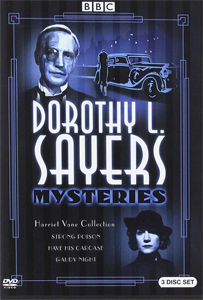
Considering that Dorothy L. Sayers was for a time nearly as famous as Agatha Christie, it’s surprising that it took a half century for her popular romantic pairing of Lord Peter Wimsey and Miss Harriet Vane to fully come to TV. Oddly, “Busman’s Honeymoon” (1937), the last of the quadrilogy about the sleuths – Peter an expert but unofficial, Harriet a mystery novelist and amateur at the real thing – had been adapted into a feature film (1940’s “Haunted Honeymoon”) and two British TV films (1947 and ’57).
But it’s in the first three Wimsey-Vane books – “Strong Poison” (1930), “Have His Carcase” (1932) and “Gaudy Night” (1935) — that we get to know them. Wimsey is in love with Harriet and she keeps declining his proposals, but her nuanced reasons are genuine and reflect a woman’s increasing possibilities in British society at the time. These three books are adapted over 10 episodes of “A Dorothy L. Sayers Mystery” (1987, BBC Two and PBS). (“Busman’s” rights were not available, but one could argue that’s an epilog to the trilogy anyway.)
Because this elegant series is so faithful to Sayers’ novels, my critiques are the same as for the novels, with “Carcase” (four episodes) marking Sayers at the top of her plotting powers, “Poison” (three episodes) hooking us on the pair but being clunky in its flow, and “Gaudy” (three episodes) lacking high stakes but having a lot to say about burgeoning women’s colleges.

“A Dorothy L. Sayers Mystery” (1987)
10 episodes, BBC Two and PBS
Adapts: “Strong Poison,” “Have His Carcase” and “Gaudy Night”
Directors: Christopher Hodson, Michael Simpson
Writers: Philip Broadley, Rosemary Anne Sisson
Stars: Harriet Walter, Edward Petherbridge, Richard Morant
“Poison” is melancholy, as Harriet is wrongfully on trial for the murder of her fiancé; a smitten Peter comes to her rescue by solving the case. She owes him her liberty, but her brain is a muddle as she had to come to terms with being executed by the state. Peter, always understanding, carefully navigates the situation.
No rush into romance
Harriet Walter, with her accented yet articulate speaking style, is exactly as I imagined Vane. She’s immediately sympathetic due to her plight, and consistently likeable soon after that. Edward Petherbridge is a more fey take on Wimsey than I expected, impeccably dressed and often adjusting his monocle. I was slower to warm up to him, but it’s hard to dislike someone who loves Harriet, and since I didn’t fully grasp him in the novels, I was flexible. He’s a throwback to a time when nobles could live leisurely on their inheritance, but they were also expected by citizens to be morally upright. Wimsey takes his position seriously.

“A Dorothy L. Sayers Mystery” – originally to be called “Harriet Vane,” and called “Lord Peter Wimsey” in the U.S. – is shot in the 1980s British style seen in some Christie adaptations. The outdoor scenes and wide interiors are shot in cinematic style (fewer frames per second) and the indoor small-group conversations and close-ups are in soap opera style (more FPS). I got used to it because the acting quality does not alter based on the camera type.
“Carcase” takes us deep into the mystery along with Vane and Wimsey, who thrillingly decipher a code. We get a weather-beaten sense of place along the coast, as Harriet finds a fresh corpse on a large rock that’s on the beach at low tide and surrounded by water at high tide. This adaptation has the most colorful cast of characters, including Colin Higgins as the squinty-eyed Mr. Bright, who unwittingly sold a razor to the killer and aims to collect a reward.
“Gaudy Night” is Sayers’ most ambitious work among the trio, but it’s unwieldy. I did keep track of the college’s warden, dean, professors and employees more easily than in book form – helped in part because the students are dropped – but it’s still a muddle of names and faces. It lacks the immediacy of Vane’s life being on the line or a murderer being on the loose. Rather, someone at the college is merely scattering poison-pen letters and doing vandalism, and the intended sense of menace never breaks through the British properness.
The final episode does boast a dramatic summation gathering to cap its ponderings on whether women should be single and in academic careers, or married and housewives. Through a modern lens, it leaves out the “have it all” option, but it’s a fair snapshot of the 1930s U.K. The adaptation is strikingly suspicious of women’s colleges — though not necessarily for gender reasons, as Wimsey notes his concern about any cloistered society, including monasteries.
Faithfulness makes for an unusual TV structure
Richard Morant joins Walter and Petherbridge in appearing in all 10 episodes as old reliable butler Bunter. Other amateur investigators are invented by Sayers as needed, namely Miss Climpson (Shirley Cain), who gets “Poison’s” showpiece, an amusing segment wherein she fakes a successful séance in order to acquire a key piece of the puzzle.
If “A Dorothy L. Sayers Mystery” was a TV series with new stories, Climpson would be among a team of recurring helpers. If a viewer didn’t know these were faithful adaptations, they’d wonder why we get long stretches with helpers, rather than the leads. At its worst, the series is a freeze rather than a slow burn (the judge’s long outlining of the facts of the case in episode one might scare some people off), but it rewards patient viewers.
The whole structure is unorthodox for a TV series, with Harriet starting as the precious object that must be saved. Peter then regularly confesses his love – but it never detracts from the mystery, since “Carcase” is such a good one – and then wins Harriet over. But not in an Anakin-and-Padme way where the script says so; we’ve seen enough of the thoughtful Harriet to know Peter had made inroads.
Throw in the lack of cliffhangers at the end of each episode – instead it’s a soft segue into Joseph Horovitz’s delicate score behind the credits — and this is not how original TV scripts would be penned. But the writers make the right choice by trying to get into the author’s mind’s eye. No one has tried to re-adapt these books, and there’s no need. I can see why “A Dorothy L. Sayers Mystery” is treasured by fans.
Sleuthing Sunday reviews the works of Agatha Christie, along with other new and old classics of the mystery genre.