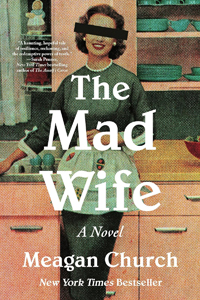
Meagan Church’s “The Mad Wife” (September 2025) is maddening. The subject matter is worthy and still relevant today – a Fifties housewife is physically and psychologically fatigued from her proscribed routine – but the book doesn’t reach a next level of profundity.
It ends up reading like a YA novel about an adult subject. Long after we get the point that Lulu Mayfield is unfulfilled by her chosen life as a homemaker for husband Henry and full-time mother to Wesley, Church remains stuck in a loop. Much like Lulu, but this parallel is not to “The Mad Wife’s” credit.
The stage-setting is quite clear. Greenwood Estates is aesthetically a fresh slice of suburbia, but it has an undertaste like the aluminum in the newfangled TV dinners. Lulu is the trope of the housewife who doesn’t want to become a Stepford Wife.

“The Mad Wife” (2025)
Author: Meagan Church
Genres: Historical fiction, thriller
Setting: 1950s suburbia
Watch that first step, it’s a doozy
That seems to have befallen all her friends on the block – partly due to under-characterization – but especially newcomer Bitsy, who has a frozen smile but occasionally malfunctions, overreacting to her daughter leaving her line of sight. Rumor has it she underwent and out-and-out lobotomy.
Henry is a driven breadwinner, and Wesley is a good kid, and no one is particularly horrible to Lulu, but she feels no one would sympathize. All very relatable, both within the Fifties Housewife trope and beyond. (For example, a single dad in the 2020s could have just as stressful a collection of duties, perhaps even more so. And a single person with no kids could have psychological issues.)
The problems with “The Mad Wife” are it doesn’t build toward new insights about Fifties suburbia and the prose – while crisp – is not poetic enough to make the novel worthwhile on its own. What’s more, Lulu’s ultimate decisions are stuck in the Fifties to the point where the book is ideologically outdated hot off the presses.
Although Lulu is the most robust character (simply because she’s the narrator), she is not all that layered. She’d like to work as a photojournalist, and probably could at the local paper. But mostly she’s in a malaise because she’s not cut out to stay at home; a farm girl, she’s wired to be out and about.
Compare this to TV’s “The Marvelous Mrs. Maisel,” where the title character is driven toward a stand-up comedy career, or to “Swingtown,” where a woman who has totally bought into the housewife mold is exposed to the swinger lifestyle. Lulu’s desire for something vaguely more is dramatically flat.
Split into two parts (Spoilers)
“The Mad Wife” includes a couple changes of direction that are overhyped but notable enough to be hidden behind a SPOILER WARNING.
The book is split into two parts, and part one ends with the revelation that Lulu has not been rocking with her baby Esther each night, but rather with an empty blanket. Off-page, the couple’s second child was stillborn, but her brain blocked it out and created an alternative fantasy.
This didn’t land with much impact for me, for a couple reasons. One, no one gets deep characterization other than Lulu, so it’s not surprising to learn Esther is literally not a character. Two, I’ve seen this twist before, where a character is only in someone’s head, so many times that I consider it to be a possibility in all stories about mental instability. This precise twist is done with much more impactful horror in the TV show “The Servant.”
Shocking, but not in a good way (Spoilers)
But the revelation does provide a jumping-off point for part two, and “The Mad Wife” still has a chance at greatness here. But as we move to Lulu’s time of getting (mis)treated for her mental condition, we simply get a YA-style story about Fifties mental wards. And it ends up enraging me how Lulu simply forgives Henry for signing off on her getting electroshock treatment.
Granted, the fact that she rolls with that punch is what the character might do. And granted, it would be a 2025 insertion of values if she divorced Henry. But dang is it unsatisfying to read. I doubt this is the point Church was aiming for, but the book is essentially saying make the best of it even with people who sign you up for electroshock treatment. Bah gawd!
And for such a straightforward and familiar setup, “The Mad Wife” is inconsistent in its messaging. On one hand, Lulu is driven mad by societal structure and strictures. On the other hand, that’s beside the point because it’s just a distraction to the doctor who is awful at his job; he misses obvious signs that she has the physical condition of lupus.
Church clearly aims for a happy ending, but instead of having Lulu devise a healthy balanced schedule and Henry vow to adjust to her needs, the author has her forgive Henry and decide to strive to accept the world as it is. “The Mad Wife” fights against a world of squares, then advocates for it, but it doesn’t land like a tragic twist. More like the book suffered a lobotomy.