
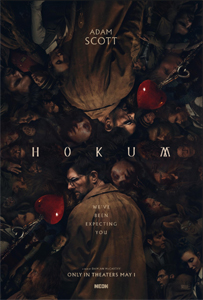
Writer-director Damian McCarthy, as he did on “Oddity” – my favorite movie of 2024 – continues to show a knack for blending horror escapism and thrilling real situations into something newly chilling. But in “Hokum,” the direction is better than the writing, making it a step down in quality.
It will probably draw a bigger audience than his breakthrough, because Adam Scott (“Severance”) has the lead role as Ohm Bauman, an acerbic American author. McCarthy is overly attached to a conceit that frames “Hokum”: We see a bleak ending to Bauman’s latest novel, about a man deciding to kill his companion in the desert. (That he’s a bestselling author might be the film’s most fantastical element.)
Bauman is cynical, so when he travels to a woodsy Irish hotel to spread his parents’ ashes, he doesn’t believe the bellhop’s story of seeing a witch. He calls the story “hokum.” His own depression, leading to meanness toward everyone, is bleak enough without adding the supernatural.
“Hokum” (2026)
Director: Damian McCarthy
Writer: Damian McCarthy
Stars: Adam Scott, Peter Coonan, David Wilmot
A suite of scares
Though he might be marketing-based casting, Scott is good in the role, because he’s a naturally likeable actor playing a mean person. It’s pleasant to watch him shoot the breeze with bartender Fiona (Florence Ordesh) and kindly vagrant Jerry (David Wilmot) as mood is built and we wait for the outright scares.
They come via “Hokum’s” best character: the hotel. The elevator that exclusively serves the honeymoon suite is locked due to the suite being haunted; sometimes the bell for the suite rings at the front desk. A malfunctioning dumbwaiter is the only access to a blocked-off basement that houses a witch.
McCarthy creates a handful of excellent sequences based on logistics and the hotel’s weird architecture. A down-to-earth human spat tastily interacts with fantastical but well-established hints of the witch and her underground world.
“Hokum” might feature the best sequence of a target trapped in a small space as a villain charges toward them since the kitchen-cabinet scene in “Jurassic Park.” And the witch’s basement has a goosebump-inducing blend of emptiness and menace.
McCarthy’s misfire is his (and Bauman’s) interest in what’s real and what’s in people’s heads. It’s not that interesting to begin with, and the framing story of Bauman’s fictional writing is unnecessarily confusing. In another area – the witch mythology – McCarthy holds back, and that actually makes that part creepier than the typical “explain it all” structure. If “Hokum” had stuck entirely with the hokum, it might’ve been another “Oddity.”