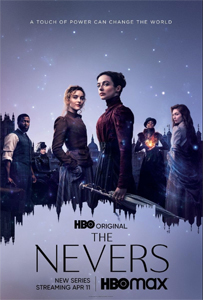
If we never get another Joss Whedon project, the common view is that he went out ignominiously by departing “The Nevers” after Season 1A (2021, HBO), citing exhaustion while also being culturally canceled when reports of mistreating past actors and writers emerged. In terms of quality, though, “The Nevers” Season 1B (2023, Watchlist by WB TV) is actually very respectable.
Using lazy, unsubstantiated forensic analysis of the credits, I note that longtime Whedon disciple Doug Petrie remains one of the executive producers for these final six episodes, so perhaps he deserves credit. Philippa Goslett ably takes over as the showrunner, and an entire crew of brand-new writers and directors smoothly takes the reins from the first six episodes where we were introduced to an 1899 London peppered with “the Touched” (superpowered people).
The biggest surprise to me is that the budget (the creation of 1899 and the superpower special effects) does not suffer notably, even though these episodes were made after the show’s cancellation for tax-advantage purposes. And even though everyone involved knew far fewer people would see them than is normal. (Episodes of Season 1A have 1,000-2,000 reviews each on IMDb; episodes of Season 1B have 100-200 reviews. The episodes are only live-streaming in Watchlist’s rotation and not recordable, unless you’re a well-equipped tech genius on par with “The Nevers’ ” Penance.)
“The Nevers” Season 1B (2023)
6 episodes, Watchlist by WB TV (Tubi live streaming)
Creator: Joss Whedon
Executive producer: Philippa Goslett
Stars: Laura Donnelly, Ann Skelly, Olivia Williams
The ‘Nevers’ ’ ending story
Not surprising but nonetheless respectable: The acting and character building are impeccable. For instance, I can hardly imagine Ann Skelly’s Irish-accented Penance – who can see electrical workings and is therefore a brilliant inventor – in a world other than 1899 London. Yes, it’s partly because she’s wearing a very fashionable Victorian dress in the last two episodes, but even so.
Her bond with Laura Donnelly’s Amalia – a time-hopper/body-swapper from the future who is the leader of the Touched enclave — is among the best female friendships on TV since Buffy and Willow. And Penance’s romance with Augie (Tom Riley) produces one of the most Whedonian scenes of Season 1B, as the ultra-propriety-minded lad assures her he’s only trying to kiss her “in a general sense.”
Now it should be noted that this definitely calls to mind “Firefly’s” Simon-and-Kaylee. And the insane sometimes-villain, sometimes-hero Maladie (Amy Manson) continues in the tradition of Drusilla and River. When watching “The Nevers,” I’m aware of the Whedonian tropes, but also impressed with how the show transplants these tropes to the 19th century.
What’s old feels new again; for example, the matriarchal community. Seeing a scene where a dozen women are gathered for battle strategy against an incursion of Purists (those who hate and fear the Touched), it’s not groundbreaking two decades after “Buffy” Season 7. But it has impact since 1899 London was a more restrictive time and place for women.
Everything is packaged in a fresh way. A “ghost in the machine” subplot about a mad scientist (Denis O’Hare) discovering a time-traveler in the phone lines is creepier than the “Buffy” Season 4 and “Age of Ultron” stories due to the time-period incongruity.
Never say ‘Nevers’ again
After Whedon practically invented Xennial slang on “Buffy,” and imagined a Chinese-English blend for the future of “Firefly,” in “The Nevers” Myrtle (Viola Prettejohn) speaks in smooth-flowing gibberish. She has the ability to understand all languages but, as a price, she can’t speak in any language. The powers of the Touched always have tradeoffs.
The most fascinating (especially if there had been a Season 2) tradeoff is in the characterization of Augie, who truly is as innocent as he seems when pseudo-flirting with Penance, but likewise proves to be a killer. (His Touched power is the ability to call birds to do his bidding.) Normally a good judge of character, Penance might be off base with Augie; it would’ve been heart-wrenching to see that play out.
I’m dropping Whedon’s name a lot, even though he had little to do with Season 1B, but that’s actually a compliment to Goslett and her team for so ably taking the reins. If Whedon was well-liked, these six episodes would serve as a final tribute to what (for now) seems to be the last gasp of his career.
“Tribute” is perhaps not the best term when talking about someone who is not well-regarded for his treatment of fellow humans. But on the other hand, these episodes show that TV is not the work of one individual. I’m extremely skeptical about the announced “Buffy” continuation on Hulu (something we’ve been threatened with for years, but now with Ryan Kiera Armstrong cast as the modern-day Slayer, I have to accept it is real).
But “The Nevers” provides evidence that other writers can continue a Whedon show and do it very well. Even if the evidence is hard to find on Watchlist by WB TV.