
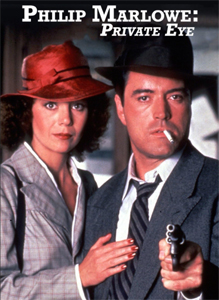
The Eighties were a wild time for many people, but not for Philip Marlowe. After a robust 1970s revival with three film adaptations, the only 1980s appearance of Raymond Chandler’s iconic noir detective is in “Philip Marlowe: Private Eye” (1983, 1986), which is largely forgotten despite being HBO’s first dramatic series.
As the title character – and the only main character – Powers Boothe knows what he’s doing in his speaking style and movements, and he wears a fedora well. I gladly accept him as Marlowe for 11 episodes (five in Season 1, six in Season 2). Those responsible for the show’s style in Season 1 know what they’re doing: the voiceovers, the hot L.A. setting, the dark streets, the pocket guns and the brass music.
Season 1’s guest stars are decent, including two brief attempts at regular co-stars. Billy Kearns plays Lt. Victor “Violets” Magee (four episodes). He’s a stand-in for Chandler’s Bernie Ohls, but a tad kinder to Marlowe. And Kathryn Leigh Scott (two episodes), who I recognize from the pilot episode of “Police Squad!” because I’ve seen it an embarrassing number of times, plays Annie Riordan, a welcome continuation of her introduction in Chandler’s “Farewell, My Lovely.”
“Philip Marlowe, Private Eye” (1983, 1986)
HBO, 11 episodes
Producers: Gabriel Katzka, David Wickes; based on the short stories by Raymond Chandler
Stars: Powers Boothe, Billy Kearns, Kathryn Leigh Scott
In Season 1, “Private Eye” flirts with becoming procedural, with Marlowe accepting spillover cases from Magee and enlisting Annie, and all five episodes are good. While the procedural route is not the way to go, an overcorrection then makes the remainder of the series scattershot.
Nearly a procedural, then nearly a mess
The first couple episodes of Season 2 are respectable – although I hate how the once-stylish opening credits turn generic — but then “Private Eye” falls off a cliff, with the plots becoming even less decipherable than the source material. And I’m not the biggest fan of Chandler’s shorts to begin with; I vastly prefer the novels.
The casting department particularly flounders, landing what seem to be Canadian community theater actors who don’t know the noir style. Several male actors fail to capture the hard-bitten speech pattern, and the wardrobe and makeup departments fail to transform the women into showstoppers.
The closest we get to chemistry between our lead and the femme fatale is Helen Shaver in “Spanish Blood” (2.2), with its “Maltese Falcon”-esque conclusion. This relatively strong episode also features a long, choreographed fight – rare for this series — that might’ve given John Carpenter ideas for “They Live.”
Setting aside the acting quality, it’s surprising how the series lacks big names. Robin Givens, who plays a woman too young for Marlowe in “Pickup on Noon Street” (2.3), might be the most notable, and she’s most famous as Mike Tyson’s ex.
It’s an eye-opening reminder that HBO didn’t hit the ground running. The series is structurally notable, though, for its three-year gap between seasons and the shortness of the seasons, things that were unheard of back then but commonplace now.
Marlowe takes others’ jobs
“Private Eye” is also important for Marlowe-ologists because it continues the gradual process of turning all of Chandler’s detectives into Marlowe. All 11 episodes come from Chandler short stories, but only “The Pencil” – the author’s last short story but the series’ first episode — starred Marlowe in its first printing.
For “The Simple Art of Murder” (1950, with the collection “Trouble is My Business” later spinning off from it), John Dalmas becomes Marlowe in “Trouble is My Business” (2.5) and “Red Wind” (2.6) and Carmady morphs into Marlowe in “Finger Man” (1.3). (Also, Carmady becomes Marlowe in “Goldfish,” which is not adapted for “Private Eye.”)
In “Private Eye,” Marlowe nearly completes his absorption of Chandler’s other detectives. He now becomes the protagonist of Mallory’s “Blackmailers Don’t Shoot” (2.1) and “Smart Aleck Kill” (1.5), Johnny de Ruse’s “Nevada Gas” (1.4), Sam Delaguerra’s “Spanish Blood” (2.2), Carmady’s “Guns at Cyrano’s” (2.4), Pete Anglich’s “Pickup on Noon Street” (2.3) and Steve Grayce’s “The King in Yellow” (1.2).
The latter is notable because it requires Marlowe to be the on-site detective at a hotel. Writer Jesse L. Lasky Jr. deftly handles the assignment: Marlowe is the fill-in house dick, a way for him to pick up extra bucks. We know he needs it, with his oft-repeated modest fee of $25 a day plus expenses. (Since he has now bumped Dalmas, Mallory and Carmady out of the way, maybe he can charge more.)
Watching Season 1 is a pleasant day’s work, but in Season 2 you’ll earn your money. Boothe is good enough that the viewing experience is never as bad as a beating from L.A. thugs. The show briefly flirts with putting HBO’s original programming on the map long before the time of “Oz” and “The Sopranos.” But in the end, “Philip Marlowe, Private Eye” settles for being a fascinating footnote.
Sleuthing Sunday reviews the works of Agatha Christie, along with other new and old classics of the mystery genre.