
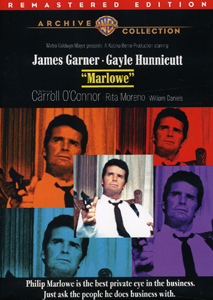
Philip Marlowe featured in film noir/Old Hollywood blends in adaptations of the first four Raymond Chandler novels in the Forties. He does his hardboiled detecting but wraps it up with a kiss over “The End.” The Fifties then saw a generic P.I. on TV’s “Philip Marlowe.”
“Marlowe” (1969), adapting fifth novel “The Little Sister” (1949), is a comeback. It brings the detective into the Swinging Sixties and paves the way for James Garner to play a similar sleuth in “The Rockford Files” (1974-80).
Stirling Silliphant (“The Poseidon Adventure”) adapts the book with reasonable faithfulness, but moves Chandler’s story into contemporary times and movie-fies it in several ways. Though not loaded with action, “Marlowe” makes good use of Bruce Lee as a mob enforcer. The way Marlowe dispatches Winslow Wong in his departing fight scene is not something you could predict ahead of time.
“Marlowe” (1969)
Director: Paul Bogart
Writers: Stirling Silliphant (screenplay), Raymond Chandler (novel)
Stars: James Garner, Gayle Hunnicutt, Carroll O’Connor
Ironically, considering director Paul Bogart’s film is modernized, it has the most Chandler-esque ending of the series so far, eschewing the kiss. On the other hand, it also eschews Marlowe’s loneliness, at least outwardly. Unnecessarily running counter to the book’s ethos, he has a live-in love interest, Julie (Corinne Camacho), who is not in the novel.
This isn’t a film for the face-blind, as the femme fatales include Orfamay (Sharon Farrell), a young, out-of-her-depth Kansan who desperately wants Marlowe to search for her missing brother; Mavis (Gayle Hunnicutt), Orfamay’s sister and a Hollywood starlet; and Dolores (Rita Moreno), Mavis’ roommate and a burlesque dancer. Dolores’ different looks as a brunette and as a blonde could cause unintended confusion.
Marlowe steps out of Chandler’s time
“Marlowe” is faithful to “The Little Sister’s” characterizations and names, also including the police duo of Lt. French (Carroll O’Connor) and Sgt. Beifus (Kenneth Tobey). It gets closer to portraying the uglier side of the police – and their mistreatment of Marlowe – than the Forties films are willing to do, and is therefore more in line with Chandler.
Marlowe is on the cockier side. It’s hard to understand why he aggressively tries to find another client to make this case official while rejecting Orfamay’s request for him to take it, unless he’s following a gut instinct. He’s interested in protecting Mavis more so than simply following clues, thus making Garner’s character brazenly moral like Chandler’s. But it’s blunt – not an internal struggle so much as an ingrained ethos.
Although he takes a licking, Marlowe’s rough days are more physical than mental. Because he has Julie at home, that softens the idea of any gnawing romantic interest he might have with the three women who are attractive but untrustworthy. A free-love-era vibe seeps in, though not to the degree of “The Long Goodbye” (1973); it’s more of a style than a theme.

Chandler is more direct than Silliphant in studying the morally corrupting influence of Hollywood via Mavis. With a plot that’s hard to follow in the details (no surprise with this series) and movement between tons of characters, “Marlowe” doesn’t connect with an overarching message. It doesn’t have the spark of Forties films like Dick Powell’s “Murder, My Sweet” and Humphrey Bogart’s “The Big Sleep” – both of which are fine romances — nor Elliott Gould’s “The Long Goodbye,” the emotionally truest adaptation.
But it is brisk, well-acted entertainment, and in terms of looks and age, you can’t argue with the casting of square-jawed Garner, a lady magnet whether he likes it or not. As I say with most Marlowe actors, I would’ve been happy to follow him in the role, but he is of course one-and-done. With “Marlowe” in his case file, though, Garner’s license as Jim Rockford is laminated and ready.
Sleuthing Sunday reviews the works of Agatha Christie, along with other new and old classics of the mystery genre.