
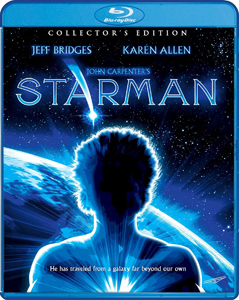
Of John Carpenter’s 18 theatrical films, 17 are horror, action or dark comedy, and the 18th is the sci-fi romance “Starman” (1984). Although he’s rightly known as an innovator and low-budget DIY problem-solver, he also could’ve been a reliable work-for-hire director if he wanted to, and this alien-visitation road-tripper proves it.
Granted, “Starman” would be nothing without the chemistry of Jeff Bridges and Karen Allen. Bridges plays the alien who looks like Wisconsin man Scott, who recently died in an accident. Allen is Jenny, Scott’s grieving widow. She drives Starman to Arizona so he can reunite with his brethren.
It’s also helped by a riff from composer Jack Nitzsche that is to “wistful and sentimental” as John Williams’ “Jaws” notes are to “intense.” You can mentally paste any loved ones or memories atop it. Cinematographer Donald M. Morgan showcases the beautiful open Midwest and Southwest as Starman and Jenny go on the road trip. At its high points, the movie is visual and aural poetry.

“Starman” (1984)
Director: John Carpenter
Writers: Bruce A. Evans, Raynold Gideon
Stars: Jeff Bridges, Karen Allen, Charles Martin Smith
Chemistry from the stars
“Starman” is delicate and sentimental; unoriginal but hard to dislike. Allen blunts her tough edge from “Raiders of the Lost Ark” and looks sad, but her smile lights up even the biggest screen. Bridges looks totally human but cleverly speaks in a way wherein Starman is learning both English and how to mechanically use his voice box and mouth parts. Physically, he’s learning how to use his body. Their relationship is bittersweet but packs a punch as we realize this is a story about saying goodbye, rather than a second chance.
The writing team of Bruce A. Evans and Raynold Gideon, whose other big credit is “Stand by Me,” are content to use standard roles from alien-visitation films. Charles Martin Smith is the SETI guy with a sense of wonder; Richard Jaeckel is the evil Army head who already has the autopsy table ready.
Though Starman had come to Earth in response to Voyager 2’s invitation on a gold record (launched in 1977), the Army only wants to control him, and kill him and study his corpse at the slightest twitch. Shermin, the SETI guy, points out: “OK, screw morality. What the hell ever happened to good manners? We invited him here!”
The cuts to Shermin keep the pacing lively and comforting. I would’ve liked more comedy, but although he can do pitch-black satire, Carpenter is not elite at straight humor. When Starman utilizes “Up yours” against a gang of roadhouse bozos, it’s not as great as the T-800 learning American vulgarities.

“Starman” forces us (and Jenny) to reflect on broad oddities of human behavior, such as eating dessert last because “that’s how we do it.” The alien, an anthropologist of sorts, vaguely notes that humans are an odd mix of positive and negative traits, and that we are at our best when things are at their worst. It’s ill-defined pro-human propaganda, but humans are the one group all moviegoers allow to be propagandized. Especially when Nitzsche’s riff plays behind it.