
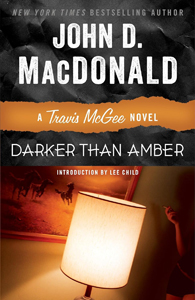
“Darker Than Amber” (1966), though the seventh Travis McGee novel, becomes the first to be adapted to the screen. (One other, an adaptation of “The Empty Copper Sea,” would come in 1983.) It’s a sensible choice. It’s the simplest story in John D. MacDonald’s series to this point, and the first to feature Meyer – McGee’s best friend and sounding board – as a major player in the plot.
The novel’s chronological placement hurts it. “Amber” comes after the masterful “Bright Orange for the Shroud.” That novel features a complex con game and McDonald’s compelling armchair exploration of how a person’s degree of masculinity and femininity allows for the expression of their psychopathy.
“Amber” has a simpler con game: The women attract and drug old men, then the con’s male leaders kill the men and steal their cash. The way McGee and Meyer get into it is striking: As they are fishing under a bridge, a woman — not named Amber; she’s actually Vangie, with dark amber eyes – comes flying through the air with a cement block strapped to her foot. She knows too much and is disposable.

“Darker Than Amber” (1966)
Author: John D. MacDonald
Series: Travis McGee No. 7
Genre: Hardboiled mystery
Setting: South Atlantic coast of Florida, 1966
“Darker Than Amber” (1970)
Director: Robert Clouse
Writers: Ed Waters (screenplay), John D. MacDonald (novel)
Stars: Rod Taylor, Theodore Bikel, Suzy Kendall
Our heroes rescue her and learn about the scheme, and McGee decides to shut it down and take the cash that can’t be returned to victims. What’s notable here is McGee’s view of the women – first Vangie and later Del.
Their physical attractiveness can’t pierce his barrier wherein he sees they are scum. At least Vangie is remorseful, believing she has earned her execution. But the quickness with which Del is ready to leave conman Terry and be loyal to the new controlling man in her life particularly repulses McGee: “With an instant practicality, she’d changed masters,” MacDonald writes in chapter 11.
Strong casting, at least in appearance
The first thing I must comment on about director Robert Clouse’s 1970 film of “Darker Than Amber” is of course the casting. Theodore Bikel is a perfect Meyer: large, uniquely bearded and smirkingly loyal to McGee. Square-jawed Rod Taylor (“The Birds”) is a good McGee in still-photo appearance. When he’s steering the Busted Flush with his feet and wearing a blue tank top, it reads “cool Seventies beach bum.”

What’s going on behind the eyes of MacDonald’s McGee is missing; not that he’s a buffoon, but Taylor doesn’t project intellectual depth. Maybe if writer Ed Waters had tried noir narration, he would have. The first-person novels are naturally introspective, but the film is plot-driven and the relationships are shallower: somewhere between the book version of McGee and cinema’s James Bond. (My ideal screen McGee would be a 2000s Thomas Jane.)
Instead of McGee carefully stalking the villains, conmen Terry and Griff (William Smith and Robert Phillips, both imposing in the brutal fight scenes) track our hero. The movie’s sloppier McGee has left a trail of clues that Vangie (Suzy Kendall) has survived. A movie needs that suspense, I suppose.
Waters stays true to MacDonald’s McGee early in his relationship with Vangie – he’s a gentleman, and clearly explains he’s only interested in relationships with an emotional attachment. But later, the playboy status of Taylor’s McGee becomes ingrained when he hooks up with Del (Ahna Capri).
Although Vangie and Del are more evil in MacDonald’s novel, they are at least subjects rather than objects, as they are in the film. Neither is an anti-woman text. The author’s and the filmmakers’ Merrimay, who poses as Vangie as part of the plan, is brave and heroic yet short of magical perfection. In a parallel to how “Vertigo” does it, the fake Vangie is played by the same actress, Kendall.
A fun curiosity, but I’ll stick with MacDonald’s prose
Broadly though, Waters and Clouse troll shallower waters, simplifying the women and most regrettably excising the deliciously pitch-black denouement that illustrates what McGee thinks of Del. Playful music backs wordless buildup, like the filmmakers see hardboiled detection as fun and games.
The fights, on the other hand, are so vicious as to be almost legendary among people who seek out obscure old movies. It looks like Taylor and Smith are literally fighting, and the web tells me they were!
Overall, its obscurity makes me fond of “Darker Than Amber.” I’d be more critical if it was famous enough to skew the public’s view of McGee’s characterization. It’s an easy-to-watch curiosity, and I would’ve followed Taylor and especially Bikel into more adventures … but it’s just as well that there aren’t any more.
Sleuthing Sunday reviews the works of Agatha Christie, along with other new and old classics of the mystery genre.