
I sat in my armchair for hours, exercising my little gray cells to come up with my rankings of Agatha Christie’s 40 Hercule Poirot books (33 novels, one novella collection and six short-story collections).
In discussing them, I won’t say whodunit but might allude to the broad nature of the puzzle if it speaks to the book’s quality. Though they don’t factor into the ranking position, for reference purposes I’ve listed where you can find the English-language screen adaptations.
40. “The Big Four” (1927)
Christie directly combines Poirot with the type of spy intrigue later associated with James Bond as he seeks the identities of four international masterminds. It’s an uneasy mix, as Poirot is an out-of-character action hero in some scenes. Further weakening the material, it’s a series of short stories stitched together into a novel. Perhaps the raw short stories, collected for the first time in 2016, play better.
Adaptation: David Suchet’s “Poirot” Season 13 (2013)
39. “Elephants Can Remember” (1972)
A plodding novel from late in Christie’s career (it’s the last Poirot she wrote), “Elephants” uses the “mystery from the misty past” approach less effectively than the classics that rank higher. The solution centers on a trick so hoary it should perhaps be outlawed by The Detection Club. The only reason you might not guess it is because it’s so obvious.
Adaptation: “Poirot” Season 13 (2013)
38. “Double Sin and Other Stories” (1961)
Four Poirots are found here, easily highlighted by the freshly minted “Adventure of the Christmas Pudding” (a.k.a. “The Theft of the Royal Ruby”), because it has more around-the-hearth spirit than the drafty novel “Hercule Poirot’s Christmas.” Three flawed 1920s stories show signs of why they went so long before being collected: Poirot solves “Double Sin” and “The Double Clue” basically because Christie says he does, and “Wasp’s Nest” is a clunky early attempt at a character study.
Adaptations: “Poirot” adapts “Double Sin” in Season 2 (1990) and “Ruby,” “Clue” and “Wasp’s” in Season 3 (1991).
37. “One, Two, Buckle My Shoe” (1940)
Also published as “An Overdose of Death” and “The Patriotic Murders”

This is a better combination of international politics and murder than “The Big Four” but not smoothly written as Poirot’s dental checkup overlaps with brutal killings. Christie is against huge government (Communism) but also issues apologia for government as a core value system (British nationalism). It’s nice that Poirot – unlike the killer – ranks all human life above any political concern. But the villain’s reasoning is confusing even from a logistical standpoint, so this novel is less satisfying than others when you close it.
Adaptation: “Poirot” Season 4 (1992)
36. “The Under Dog and Other Stories” (1951)
These nine stories from the 1920s are like proto-“Poirots,” not making the cut for “Poirot Investigates” but later collected when Christie had become a superstar. “The Plymouth Express” is a proto-“Mystery of the Blue Train,” “The Market Basing Mystery” is a proto-“Murder in the Mews,” and “The Submarine Plans” is a proto-“Incredible Theft.” “Submarine” is actually a tad better because it zeroes in on the plotting. In this collection, Poirot’s deference to the police and the shortage of zest in his interactions with Hastings are noticeable, as Christie took a while to find her characters and rhythms.
Adaptations: “Poirot” Season 1 (1990) gives us “The Adventure of the Clapham Cook” and “The King of Clubs,” and “Market Basing” and “Submarine Plans” are represented by “Mews” and “Theft,” respectively. Season 2 (1991) delivers “The Cornish Mystery.” Season 3 (1992) provides “The Affair at the Victory Ball” and “The Plymouth Express.” Season 5 (1993) serves up “The Underdog.” “The Lemesurier Inheritance” is the only standalone short story not adapted for the TV show.
35. “The Labors of Hercules” (1947)
I find it tenuous that Poirot would desire to seek out 12 cases that stand as metaphors for the Labors of Hercules, although this collection is a reminder that Christie was well-read and often made parallels to classic literature. What bad luck that the love of Poirot’s life, Countess Vera Rossakoff, appears in three relatively weak stories: “The Double Clue,” “The Big Four” and this book’s “The Capture of Cerberus.” But I must admit that the latter provides sizzling insight into Christie’s opposition to drug use, as she names an underground club Hell.
Adaptations: “Poirot” Season 13 (2013)
34. “Murder in Mesopotamia” (1936)
This is a frustrating mix of one good trait and one bad one. Infamously, it has the most implausible twist of any Christie novel as it seems unlikely that a certain character would be fooled by another certain character. Before that, Christie ties in her knowledge of archaeological digs and associated lodgings, and this is a strong example of a story where architecture matters in the howdunit. Poirot’s “plucky young woman” helper, Amy, isn’t as memorable as others of this status, and the cast of characters doesn’t pop like it should.
Adaptations: “Poirot” Season 8 (2002)
33. “Hallowe’en Party” (1969)
Christie tended to struggle with seasonal atmosphere in her novels, especially surprising here since she hit on a horror vibe in several supernaturally tinged short stories. We get English Halloween staples like bobbing for apples, at least, and an initial victim who is good for controversy about whether an author should go there. Christie wrote this in her tape-recorder dictation period, and I wished for another editorial polish. Still, I’m happy she finally got around to a Halloween-set novel.
Adaptations: “Poirot” Season 12 (2010) and Kenneth Branagh’s “A Haunting in Venice” (2023)
32. “Poirot Investigates” (1924)
The first short-story collection features Poirot and Hastings knocking off tons of little cases in the 1920s and exchanging banter; these are snacks whereas the novels are feasts. We see tropes such as faked identities, intercepted money transfers, and jewelry being replaced with paste copies. My favorite of the 14 entries is “The Adventure of the Cheap Flat” because it shows the ultra-competitive nature of grabbing affordable lodgings in London, something still relatable today. “The Chocolate Box” is unusual because Poirot reflects on a past case he failed to solve.
Adaptations: In “Poirot” Season 1 (1989) are “The Kidnapped Prime Minister” and “The Disappearance of Mr. Davenheim.” In Season 2 (1990) are “The Adventure of The Western Star,” “The Adventure of the Cheap Flat,” “The Veiled Lady” and “The Lost Mine.” In Season 3 (1990-91) are “The Tragedy at Marsdon Manor,” “The Mystery of Hunter’s Lodge” and “The Million Dollar Bond Robbery.” In Season 5 (1993) are “The Adventure of the Egyptian Tomb,” “The Jewel Robbery at the Grand Metropolitan,” “The Adventure of the Italian Nobleman,” “The Case of the Missing Will” and “The Chocolate Box.” “Davenheim” is also the source material for the pilot episode of the rejected series “Hercule Poirot,” starring Martin Gabel, which aired as an episode of “General Electric Theater” in 1962.
31. “Mrs. McGinty’s Dead” (1952)
Also published as “Blood Will Tell”
Christie overshoots with this plot: The identity of a murderer, now going by an alias, will be revealed once Poirot learns his or her true identity (and therefore, motive). He sifts through old records for several candidates; because everyone is necessarily a cipher, the book is actually a weak character piece despite being loaded with characters. An exception is Mrs. McGinty’s lodger who has clearly been framed but who is likewise not a nice person – not enough reason to see him hanged, Poirot and Inspector Spence thankfully decide. We get good meta-humor with Ariadne Oliver’s frustrations with her readers’ pickiness.
Adaptations: “Poirot” Season 11 (2008) and Margaret Rutherford’s Marple movie “Murder Most Foul” (1964)
30. “The Regatta Mystery and Other Stories” (1939)
This includes five Poirot short stories. Most interesting from a scholarly perspective is “The Mystery of the Baghdad Chest,” because Christie later improved upon it for “The Mystery of the Spanish Chest,” found in “The Harlequin Tea Set” (1997). Another curiosity is “Yellow Iris,” later expanded for the novel “Sparkling Cyanide,” which swaps out Poirot for Colonel Race. “How Does Your Garden Grow?,” “The Dream” and “Problem at Sea” likewise feel like test runs, overshadowed in my memory by various novels’ treatments of similar ideas.
Adaptations: “Dream” and “Problem” are in “Poirot” Season 1 (1989), “Garden” and “Spanish Chest” in Season 3 (1991) and “Yellow Iris” in Season 5 (1993).
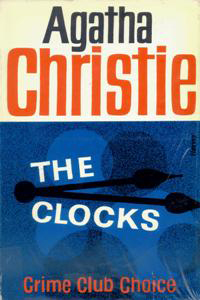
29. “The Clocks” (1963)
It’s worth your time despite not ticking along at a perfect rhythm. Set in a newish suburban development, the novel features the hook wherein Poirot goes full Nero Wolfe and solves it from his armchair, and a few almost-memorable characters and moments. A blind woman discovers the murder scene; a 10-year-old girl’s “Rear Window”-type observations might help; and Colin Lamb, the son of Superintendent Battle, probes a spy plot that’s hard to care about. Except we have to because it’s important to the solution.
Adaptation: “Poirot” Season 12 (2011)
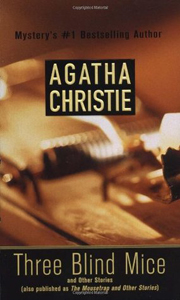
28. “Three Blind Mice and Other Stories” (1950)
Also published as “The Mousetrap and Other Stories”
This includes only three Poirots, but they are particularly good. My favorite is “The Third-Floor Flat” because a murder happens in Poirot’s building and young tenants are awed by him; it’s amusing to see Poirot get his ego stroked. “The Adventure of Johnny Waverly” has fun with the kidnapping-and-ransom formula. “Four and Twenty Blackbirds” is gripping and has a nice framing mechanism of a dinner conversation with a friend.
Adaptations: “Poirot” Season 1 (1989)
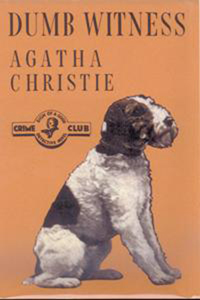
27. “Dumb Witness” (1937)
Also published as “Poirot Loses a Client”
No, the title isn’t an unnecessary insult to Hastings. Rather it refers to a dog, Bob, whom Poirot cutely befriends (he doth protest too much about the terrier’s filthiness). Actually, Bob is pretty smart – he even “talks” for our purposes – so perhaps the title refers to a character who sees a key clue but interprets it wrong. A servant inherits the late Emily Arundell’s money and all the relatives are awful people, making me wonder if this was a primary influence on “Knives Out.” Poirot’s sense of justice is on display; it’s too late to save Emily, but he feels he owes her.
Adaptation: “Poirot” Season 6 (1996)
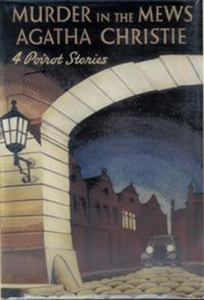
26. “Murder in the Mews” (1937)
Also published as “Dead Man’s Mirror”
This collection includes three solid novellas and one short story, “Triangle at Rhodes,” which is the best of the collection due to vacationing “Papa Poirot’s” concern about how a love triangle will play out. Also on display are Christie’s interest in political oddities (in “Mews,” are people celebrating the success or failure of Guy Fawkes with fireworks?) and spy games (“The Incredible Theft” features war machine plans). “Dead Man’s Mirror” is a foundational manor killing. (Note: “The Second Gong,” the only Poirot story in 1948’s “The Witness for the Prosecution and Other Stories,” is an early version of “Mirror.”)
Adaptations: “Mews,” “Theft” and “Rhodes” are in “Poirot” Season 1 (1989), and “Mirror” is in Season 5 (1993).
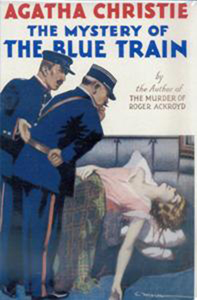
25. “The Mystery of the Blue Train” (1928)
Christie hated this novel because she contractually had to write something during her post-divorce period. But even on autopilot and expanding her short story “The Plymouth Express,” she constructs something compelling. A lot of her mid-range mysteries are elevated by Poirot getting a one-off “plucky young female” helper. Katherine Grey (who in a fun Easter egg, hails from Miss Marple’s stomping grounds of St. Mary Mead) is a delightful one. The village girl awkwardly moves through upper-crust London social functions and has her eye on a man both as a suspect and a potential love interest.
Adaptation: “Poirot” Season 10 (2006)
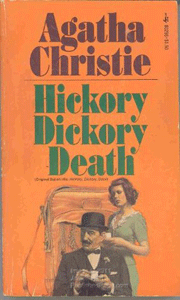
24. “Hickory Dickory Dock” (1955)
Also published as “Hickory Dickory Death”
Christie’s novels – unlike the “Poirot” TV series that confines itself to the 1930s — aren’t stuck in a time period, so we see her insights into societal developments. Here we have a London dorm featuring a wide variety of international students; never before has a dramatis personae been so crucial. The boarding house – which includes men’s and women’s wings and a common room — is filled with noise and activity, and it has a landlord and warden. It’s like “Harry Potter” in a different time, with slightly older characters. The 60-something author’s grasp of 20-somethings might not be spot on, but it’s fascinating to see her try.
Adaptations: “Poirot” Season 6 (1995)
23. “After the Funeral” (1953)
Also published as “Funerals are Fatal”
Rather than populating her casts with stiff Brits, Christie knows people come in all types, and this one particularly features three unorthodox personalities. Hooking us right away is Cora, who at a funeral of a patriarch where no foul play was suspected, she says “But he was murdered, wasn’t he?” Things then get more twisty – at least in a manner of goofy fun if you don’t buy it all. Ultimately, the author hits on the theme of non-Poirot novel “Murder is Easy” (it’s easy to get off scot-free if no one can find a motive) in a more organic fashion.
Adaptations: “Poirot” Season 10 (2006) and Rutherford’s Marple movie “Murder at the Gallop” (1963)
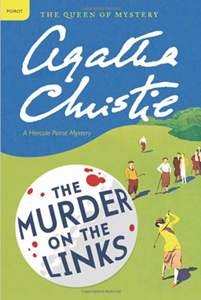
22. “The Murder on the Links” (1923)
Hastings – and his tendency to be smitten with attractive young women – takes an early spotlight in this adventure where he meets the unusually named Cinderella. Though it’s an overstuffed novel from a fairly novice author, “Links” is more subtly a parody of tropes. Hastings is the least of Poirot’s frustrations. The Belgian sleuth clashes with his foil, a French police detective named Giraud who is superficially in the Sherlock Holmes mold but who makes all the wrong conclusions.
Adaptation: “Poirot” Season 6 (1996)
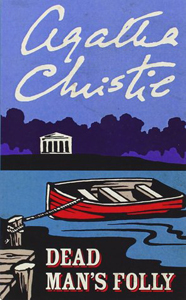
21. “Dead Man’s Folly” (1956)
This novel has an appealing carnival atmosphere as both Poirot and Ariadne are invited – to their mild annoyance — to a fete. He’s the famous guest of honor and she’s been hired to craft a whodunit game, an early take on the dinner theater murder mysteries that later became popular. Of course, an actual murder happens instead, and the solution is both creepy and hard to believe. The detectives’ discussions about whodunit are lively and the novices’ theories about “sex maniacs” and “foreigners” are amusing. The vibe is of a confident writer having a good time at the fete.
Adaptations: Peter Ustinov’s 1986 movie and “Poirot” Season 13 (2013)
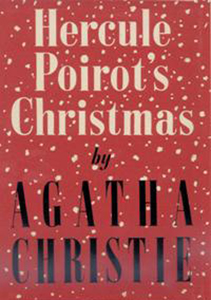
20. “Hercule Poirot’s Christmas” (1938)
Also published as “Murder for Christmas” and “A Holiday for Murder”
Christie’s novels tended to be released late in the calendar, allowing people to receive “a Christie for Christmas.” This time it’s literal. The plot itself is familiar but well done – featuring a murdered patriarch amid a manor full of family and friends – and the reveal of whodunit is a notable case of “Wow, Christie really went there.” It could’ve benefitted from more Yuletide atmosphere. But then again, I suppose it’s good that Christmas and murder don’t get too cozy with each other.
Adaptation: “Poirot” Season 6 (1995)
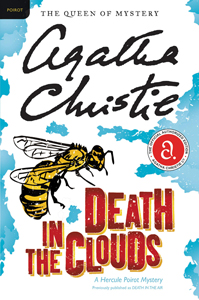
19. “Death in the Clouds” (1935)
Also published as “Death in the Air”
I hate flying, but this would be a good – if ironic – book to bring on the plane. It’s an intriguingly unusual site for a murder, creating an airtight-cabin mystery. Everyone’s a suspect, including Poirot! (Inspector Japp chuckles about that and we move on.) Poirot and one of his “plucky young women” helpers, Jane Grey, not reflective of her bland name, continue to mull the mystery on the ground. A fun thing about old novels is discovering some tech arrived sooner than I realized: Here we have an early instance of a fax, as a photograph sent over the phone line assists our sleuth.
Adaptation: “Poirot” Season 4 (1992)
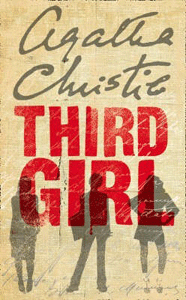
18. “Third Girl” (1966)
This is the most famous example of Christie, in her 70s at the time, digging into a younger generation. A neat logistical insight is that when young women strike out on their own, they desire roommates to share the rent; hence we have the second girl, who is likely a friend, and a third girl to round it out. Christie – through Poirot and Ariadne — is frantic about drugs and sex, but her heart is in the right place. Her brain is engaged, too, and she engages ours with the opener wherein the titular Norma thinks she might have killed someone. So then we wait not merely for information to be gathered, but for a murder to happen! The Swinging Sixties vibe is a perk.
Adaptation: “Poirot” Season 11 (2008)
17. “Cat Among the Pigeons” (1959)
It’s a tighter take on Dorothy Sayers’ “Gaudy Night” as we get to know students and teachers at a girls’ academy and a murderer gives new meaning to the term “finishing school.” The mystery has a slight “Nancy Drew” vibe as teens Jennifer and Julia get interested in the murders, and a foreign exchange student who is a princess spices things up. Ultimately Christie leans toward characterizations for the adult teachers and administrators, then Poirot comes in like Lord Wimsey to tidy things up. I like how “Cat” doesn’t spiral into a spy novel, finding a nice (albeit dangerous) sense of place on the school grounds.
Adaptation: “Poirot” Season 11 (2008)
16. “Three Act Tragedy” (1935)
Also published as “Murder in Three Acts”
For those into such nerdery, the Poirot and Mr. Quin universes get connected as Poirot and Mr. Satterthwaite are at a dinner party where someone dies from a poisoned drink. Yet there’s no poison in the other glasses and the drinks were not pre-assigned. The murder seems untargeted – and from a detective’s perspective, difficult to solve. Unusually named young woman Egg helps keep things lively. Appropriate for a story where a friend of the mysterious Quin guest-stars, Christie comments on the timelessly uneasy line between fiction and reality.
Adaptations: Ustinov’s 1986 movie and “Poirot” Season 12 (2010)
15. “Peril at End House” (1932)
This is an intense one for Poirot, who is unable to relax on his vacation. His confidence is shaken when he can’t figure out who is targeting young woman Nick Buckley at a seaside resort. Partly it’s because there are so many possibilities; his list of suspects is lettered A through J. Though identity switches that seem a little too easy (especially from the perspective of the next century) play a role, “Peril” ends with one of Christie’s great surprises — one that infuses the story with an extra layer of pathos.
Adaptation: “Poirot” Season 2 (1990)
14. “Evil Under the Sun” (1941)
Bodies lie in the sand, soaking up rays, and – as he observes shaky relationships among his fellow vacationers — Poirot worries at least one will soak up a death blow, too. Christie goes for a vibe through the prose as much as the mystery, and mostly achieves it. The way the villain pulls off a kill is brilliant, using timing fake-outs and false alibis to such a degree that Sayers might’ve called Christie to compliment her. Featuring familiar tropes like jealousies and bored teenagers, this is – appropriately — a good beach read.
Adaptations: Ustinov’s 1982 movie and “Poirot” Season 8 (2001)
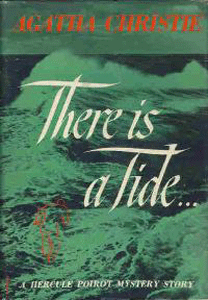
13. “Taken at the Flood” (1948)
Also published as “There Is a Tide …”
In a book that alludes to a Shakespeare tragedy, Christie acknowledges that some women – especially in a time when they have increasing options – do not hew to traditional British values. It features her most controversial love match, an extreme case of being drawn to the bad boy. The mystery is standard – patriarch is killed, young second wife inherits, everyone had a motive – but the clues and suspects are engrossing. In the end, the lack of tidiness of the Cloade family and their situations makes “Flood” an unusually lingering experience.
Adaptation: “Poirot” Season 10 (2006)
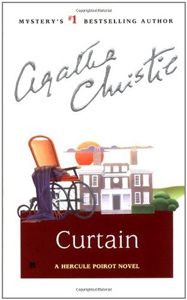
12. “Curtain” (1975)
Christie bookends the series’ 55-year run by returning Poirot to Styles, the mansion from his first novel, and bringing back best friend Hastings, who had moved to Argentina (and out of the novels, as Christie had tired of him). He narrates for the first time since 1937. This was not the last-written novel; she wrote it mid-career and put it in a vault to make sure Poirot would have a conclusive novel. It’s a daring final bow, as Poirot goes on the offensive to wrap a case, feeling pressure that the killer might strike again. His explanatory letter to Hastings doubles as an effective defense to the reader.
Adaptation: “Poirot” Season 13 (2013)
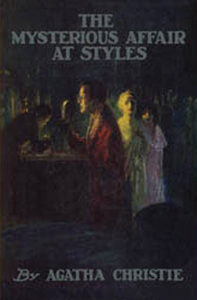
11. “The Mysterious Affair at Styles” (1920)
This is where it all begins, with a remarkably polished debut, as Christie had been working on the novel for several years before getting it published. We’re engagingly brought into the procedure of the era, including the formality of the inquest and Poirot coming out of retirement (!) to apply his order and method to the country manor house of suspects. The Poirot-Hastings banter is there from the start, as the sleuth praises his friend for “seeming” unintelligent so as not to tip off the killer. It wraps with an answer that both makes sense and likely fakes out the first-time reader.
Adaptation: “Poirot” Season 3 (1990)
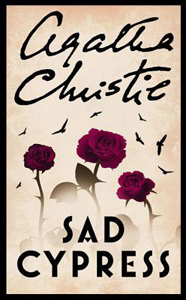
10. “Sad Cypress” (1940)
Christie kicks off her 1940s run of particularly emotional pieces with the too-selfless-for-her-own-good Elinor, the sad but stolid figure of the title with whom Poirot sympathizes. The novel centers on the mechanics of a love rectangle but wallows in the trueness of love and pauses to reflect on death. Here it’s not merely a trigger for the gains of inheritances but a matter of palpable loss. It’s a little heavier on courtroom scenes than most Christies but without sensationalism or melodrama.
Adaptation: “Poirot” Season 9 (2003)
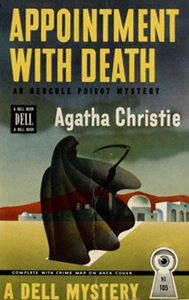
9. “Appointment with Death” (1938)
Christie asks whether it matters that the victim is a villainous person. Mrs. Boynton – literally lording over the tourist-tent encampment in Transjordania from the lip of a cave — is what we’d today recognize as a gaslighting narcissist, abusing her adult children. This is one of Christie’s elite psychological novels. The first half is a Poirot-lite interplay of personality matches and clashes, and the second half finds the sleuth sifting through psychoanalysis to figure out whodunit.
Adaptations: Ustinov’s 1988 movie and “Poirot” Season 11 (2009)
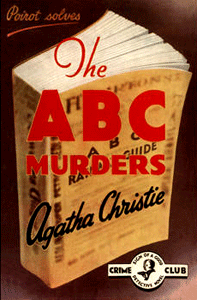
8. “The A.B.C. Murders” (1936)
Also published as “The Alphabet Murders”
This is Christie’s elite string-of-murders mystery wherein the solution relies on figuring out which murder informs all the others. Troubled door-to-door salesman Alexander Bonaparte Cust is a memorably down-and-out suspect, a contrast to a rather colorful case wherein the victims follow the alphabet (someone with the initials AA is killed in a town starting with A, and so on). It’s fun to think answers might be found in an ABC train guide, infusing a dry manual with the excitement of pursuing a serial killer.
Adaptations: Tony Randall’s 1965 movie, “Poirot” Season 4 (1992) and John Malkovich’s 2018 miniseries
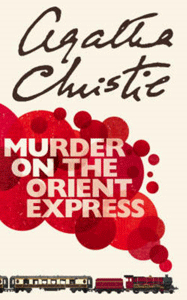
7. “Murder on the Orient Express” (1934)
Also published as “Murder in the Calais Coach”
It’s a little lower on my list than most because although it’s an elite first-time read, the twist is so memorable that it can’t be re-experienced. The procedure of Poirot interviewing subjects (all annoyed that they are stuck on the stranded train) is enjoyable, with humor coming from his impromptu helpers who jump on every clue too quickly, assuming they’ve figured it out. The icing on the cake in this snowed-in mystery is Poirot making an extra-judicial decision.
Adaptations: Albert Finney’s 1974 movie, Alfred Molina’s 2001 movie, “Poirot” Season 12 (2010) and Branagh’s 2017 movie
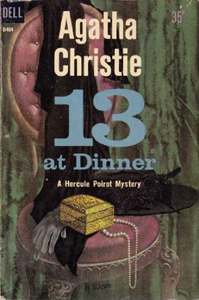
6. “Lord Edgware Dies” (1933)
Also published as “13 at Dinner”
Christie writes between the lines here, allowing us to create our own red herrings thanks to a classic but well-utilized setup wherein two characters look similar – the self-centered but naïve Lady Edgware and up-and-coming American impressionist Carlotta Adams. It seems one of them must be the killer, but why? Lord Edgeware said he was happy to grant his wife a divorce, and she knew that, so what’s her motive? The answer sheds light on a historical point modern readers might not know about.
Adaptations: Austin Trevor’s 1937 movie, Ustinov’s 1985 movie and “Poirot” Season 7 (2000)
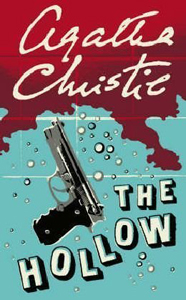
5. “The Hollow” (1946)
Also published as “Murder after Hours”
This is among the top novels wherein we get to thoroughly know the personalities and traits of all family members at a murder site. It’s more humorous than the one that ranks higher thanks to the talky Lady Lucy Angkatell, who examines the case in a totally different manner than Poirot, distracting and annoying him. And ultimately the answer is one where Poirot curses himself as an “imbécile!”; indeed, Christie regretted including Poirot in this novel and excised him from the stage version. Nonetheless, the colorful cast – including one character with acute anxiety – and several love-and-rejection linkages make this a great rom-mystery.
Adaptation: “Poirot” Season 9 (2004)
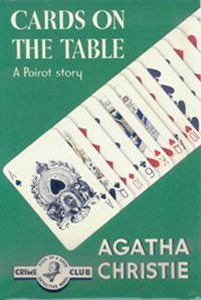
4. “Cards on the Table” (1936)
This one impresses me because there are genuinely only four suspects, as the victim is in a room where those four were playing bridge. None of them cop to the murder nor to seeing it. Remarkably, Christie keeps the suspense of wondering whodunit till the end. In a neat parallel, four investigators probe the four suspects. Among them is Christie’s stand-in Ariadne Oliver, an author who finds herself caught up in real crime-solving; she debuted in “Parker Pyne Investigates” and now enters Poirot’s world.
Adaptation: “Poirot” Season 10 (2006)
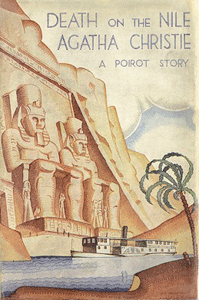
3. “Death on the Nile” (1937)
Also published as “Murder on the Nile” and “Hidden Horizon”
An emotionally fraught love triangle does not mesh well with order and method, as a frustrated Poirot finds out. Still, he’s in fine “Papa Poirot” mode on this river cruise, trying to guide heartbroken Jacqueline de Bellefort to not let evil into her heart. This marks Christie’s best use of her Middle East knowledge (from vacations and archaeological work), as the ship stops at various tourist towns in Egypt for sightseeing. The clues are sharp and the emotions high, leading to a famous (and tragic) ending, embellished by Poirot’s extra-judicial thoughts.
Adaptations: Ustinov’s 1978 movie, “Poirot” Season 9 (2004) and Branagh’s 2022 movie
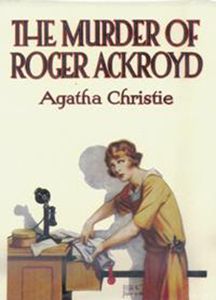
2. “The Murder of Roger Ackroyd” (1926)
It’s known for Christie’s most famous twist, the one that put her on the map as a writer to be reckoned with. I’m proud to say I guessed it – but I still appreciate the author’s ingenuity. It’s the only Christie book wherein upon seeing the answer, I paged back to a key passage to see if she plays fair (she does). On the first read, it’s a typical manor murder spiced up by a doctor’s narration and input from his quirky sister. It would also make a good second read, as our new information allows for a fresh perspective.
Adaptation: “Poirot” Season 7 (2000)
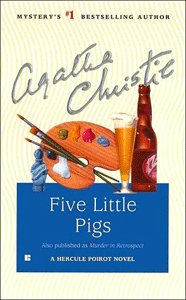
1. “Five Little Pigs” (1942)
Also published as “Murder in Retrospect”
In the 1940s, Christie wrote her most character-driven books – combinations of Mary Westmacott-style straight fiction with top-shelf puzzlecraft — and this is the masterpiece. A woman hires Poirot to solve an ice-cold case for peace of mind; her since-deceased mother was innocent of a murder and she’d like it to be proven. Five family members write first-person accounts of the fateful day when the artist dropped dead while painting, simultaneously providing clues and insight into their psychologies. We desire answers as desperately as Poirot does as the cold case turns hot.
Adaptation: “Poirot” Season 9 (2003)