The Philip Marlowe movies and TV episodes through the years haven’t exactly been a pre-planned saga. In fact, despite being a well-crafted private eye on the page by Raymond Chandler – the Everyman white knight – he’s a flexible template on screen. He has varied in age, race, timeframe and personality. The consummate Los Angeles detective even moves to London once!
In compiling evidence for the rankings of the 12 Marlowe screen appearances (skipping the 1959 TV series, which is mostly lost), the picture of his character is unclear and contradictory. And some of the evidence is a slog to get through. But much of it is fascinating, and very good when we get to the top half of the list. Here are my rankings (all are theatrical films unless otherwise noted):
Honorable mention: “Philip Marlowe” (1959-60, TV series)
Or perhaps “dishonorable” mention. The famous hardboiled private eyes aren’t interchangeable on the page, but some screen writers think they are. Philip Carey’s version of Marlowe, over 26 episodes on ABC (none adapted from Chandler), is more like a PG version of Mickey Spillane’s Mike Hammer. His toughness, or mere threats of getting tough, gets everyone to fall in line, including law enforcement. Only two episodes survive, so it’s not fair to put this series up for ranking consideration, but it’s clear it’s generic TV that’s only interested in name recognition.
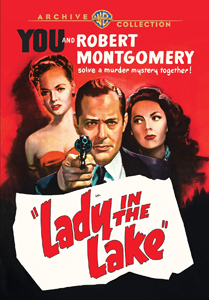
12. “Lady in the Lake” (1947)
Director-star Robert Montgomery’s film is an important experiment … and a failed one. It makes a strong case that a story told directly from the point-of-view of one character is unappealing. The camera represents Marlowe’s POV as he pursues a case. It makes Marlowe deliberate rather than brisk, and mean rather than witty. The novel’s sense of the outdoors is excised. Audrey Totter is good as the female lead but it’s not believable that she falls for this jerk. In a supporting role, take note of Lloyd Nolan, who played the detective who stands in for Marlowe in “Time to Kill” (1942), which uses the plot of “The High Window.”
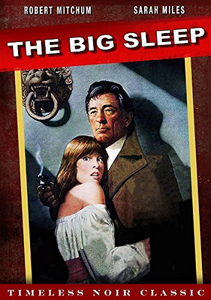
11. “The Big Sleep” (1978)
Here we have an accidental experiment. To keep costs down, the British production moves Marlowe to contemporary London but makes no adjustments to the plot. Marlowe out of L.A. is a fish out of water but not in a fascinating way; director Michael Winner’s film simply feels wrong. The 1939 novel’s plot featuring a black-market of pornographic book sellers doesn’t make sense in an era when adult magazines are on the newsstands. Robert Mitchum, the only actor to play Marlowe twice on the big screen, is still good, but everyone else – notably the would-be sultry young women Sarah Miles and Candy Clark – lacks zest. This is quite a step down from the Bogart version, but it’s worth noting that the conclusion hews closer to the novel.
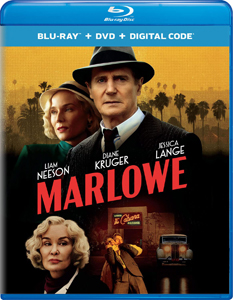
10. “Marlowe” (2022)
Cinema has a weird tendency to age up Marlowe, something Chandler never got around to. Liam Neeson, 70 at the time, is the most extreme case, but at least writer William Monahan acknowledges this with lines like “I’m twice your age.” That’s said to Diane Kruger, but the film’s standout actress is Jessica Lange, who knows how to do this noir stuff. Director Neil Jordan’s aesthetic borders on being too on-point, like the “Boulevard of Broken Dreams” painting was fed into an AI program asked to create noir. “Marlowe” comes from Benjamin Black’s pastiche novel “The Black-Eyed Blonde,” which – unlike the movie – is a masterpiece.
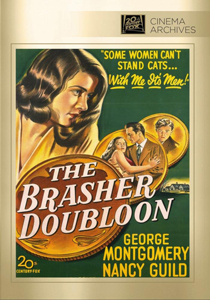
9. “The Brasher Doubloon” (1947)
Director John Brahm and writer Dorothy Bennett keep the mystery plot of “The High Window” but replace the hardboiled Marlowe with an ole softie played by George Montgomery. And they really play up Marlowe’s attachment to Merle (Nancy Guild), a scared young secretary to a verbally abusive matriarch. She’s a woman he must save and bring into the light. He teaches her about kissing in a gender-swapped “Ball of Fire.” Montgomery has nothing to do with the brasher on-page Marlowe, but “Brasher” is likeable as a wish-fulfillment romance.
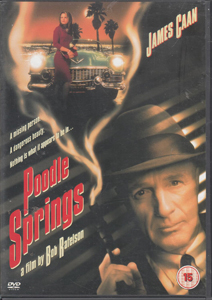
8. “Poodle Springs” (1998, TV movie)
The casting of an older Marlowe (James Caan) plays well in this HBO movie because he aims to switch his focus from detection to marriage (one guess as to which he’s better at) in this adaptation of the Chandler-Robert B. Parker mashup. His move to the development town of Poodle Springs, Calif., has the air of a retirement story, although he’s marrying the far-from-retirement Laura (Dina Meyer, always a delight). His work-life balance isn’t great in this Bob Rafelson-helmed film, but he’s still great at his work, with a confidence that can be explained by his age. Character actors (Tom Bower) and big names (Brian Cox, Joe Don Baker) help us through a decent mystery that purposely moves away from the mean streets.
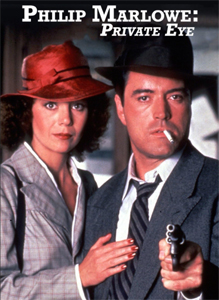
7. “Philip Marlowe, Private Eye” (1983-86, TV series)
In a way, this HBO series is the pure stuff: Chandlerian Marlowe and noir tropes shot into our veins via Powers Boothe in 11 short-story adaptations. Boothe gets my vote as the purest Marlowe, landing in that middle ground where he can draw information out of the timid but can himself be intimidated by L.A.’s bosses … or their thugs. Early episodes smartly set up his alliances with plucky possible love interest Annie (Kathryn Leigh Scott) and above-board police detective Magee (Billy Stearns), a stand-in for Chandler’s Bernie Ohls. Season 1 is all we could ask for, but then Season 2 goes cringingly cheap, particularly with the supporting casts.
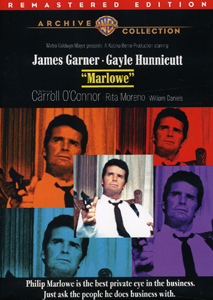
6. “Marlowe” (1969)
In retrospect, it’s like James Garner is auditioning for “The Rockford Files,” which is too bad because I would’ve liked seeing him continue in the title role instead. That’s not to say he’s a Chandlerian Marlowe; he’s more like Hammer, swimming in femme fatales and fisticuffs in this adaptation of “The Little Sister.” We’re in the Swinging Sixties in more ways than one: A rooftop fight against Bruce Lee isn’t exactly elite, but it’s certainly memorable. Though Garner’s Marlowe is too cool to have emotional depth, this is the first film in the series to dodge a Hollywood ending and stick with the book’s bleakness.
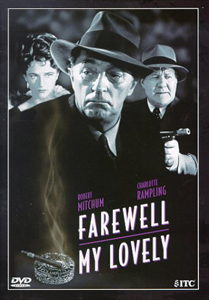
5. “Farewell, My Lovely” (1975)
Mitchum’s Marlowe is on the older side, but he’s a master at delivering Chandler’s lines. Writer David Zelag Goodman wisely retains many of them, and I suspect the Zucker-Abrahams-Zucker team asked Leslie Nielsen to study Mitchum’s deliveries for spoofing purposes in “The Naked Gun.” So, yes, director Dick Richards’ “Farewell” drips with the expected style, but it brings out the story of Chandler’s second novel more accurately than previous attempt “Murder, My Sweet.” Charlotte Rampling is a sultry femme fatale. Only an action choreography budget that must’ve hovered around $0 and a rushed ending keep it from ranking higher.
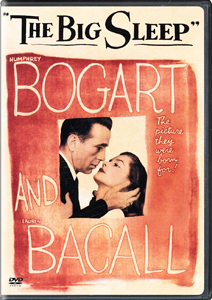
4. “The Big Sleep” (1946)
This is a rare case in Hollywood history where studio interference by all accounts improves the film. The goal was somewhat crass: to make Lauren Bacall into a star by punching up her scenes in reshoots. But it’s worth it; suffice it to say it’s easy to see her and Humphrey Bogart getting married. An unfortunate downside is that Martha Vickers, so good as the other of the two troubled sisters, gets short shrift in the final cut. Though he’s not the purest Marlowe, the way Bogart flows through the action of Howard Hawks’ movie like a chick magnet is extremely entertaining.
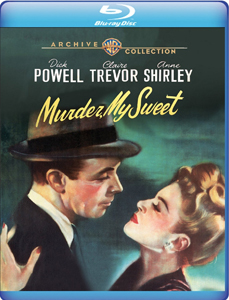
3. “Murder, My Sweet” (1944)
Maybe a bigger build like Boothe’s is more appropriate, but in terms of vibe, the first screen Marlowe, Dick Powell, is a great one – a blend of cocky, wary, weary and vulnerable in this adaptation of “Farewell, My Lovely.” The moment when he lights a cigarette on a Cupid statue’s ass is a great visual representation of his character. Director Edward Dmytryk’s smoke-filled shots, composited bleary-dream sequences and black-pool fadeouts are innovative and timeless. The love triangle – featuring a woman and her barely younger stepdaughter – provides more tension than “The Big Sleep.” And while the Hays Code happy ending is unavoidable, it’s also admittedly satisfying.

2. “Red Wind” (1995, TV episode)
A black Marlowe?! It’s not so crazy when one considers real-world L.A. detective Samuel Marlowe might’ve inspired Chandler’s creation. Writer Alan Trustman and director Agnieszka Holland’s choice of short story “Red Wind” for an episode of Showtime’s anthology series “Fallen Angels” is smart, because Marlowe (Danny Glover) is so put-upon that you might as well add racism to it. Also, he has woman troubles in the tale, so you might as well add the interracial barrier with Kelly Lynch. Glover’s natural laconic weariness is made for noir voiceovers, and it’s a shame he didn’t play either a black Marlowe or perhaps Walter Mosley’s Easy Rawlins in an ongoing series.
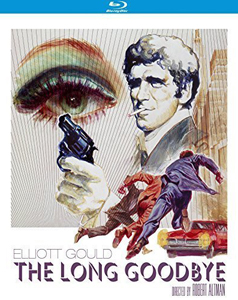
1. “The Long Goodbye” (1973)
Director Robert Altman, writer Leigh Brackett and star Elliott Gould aimed to make fun of Chandler’s tropes by moving the perhaps pretentiously long sixth novel into the steamy Seventies. How would Marlowe’s lifestyle play in reality? Would he be coolly detached or pathetically lonely? Would his zingers knock cops and criminals back a step, or would they earn him a fist in the mouth? Ironically and perhaps accidentally, “Goodbye” arrives at a purist Marlowe from an alternate angle of improvised mumblecore scenes (most famously, small Henry Gibson’s berating of massive Sterling Hayden). Often with a cigarette hanging from his lips, Gould’s detective pays an emotional and physical price throughout the messy mystery. But by the famous final scene — featuring one last uber-zinger — there’s no doubt that he’s cool.
Los Angeles image by Christian Drei Kubik from Pixabay