
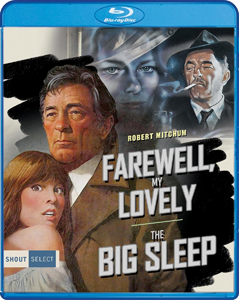
“One Marlowe for the modernists, one for the purists” was the approach to adaptations of Raymond Chandler’s sleuth in the 1970s. After Robert Altman’s controversially modern-set “The Long Goodbye” (1973), writer David Zelag Goodman and director Dick Richards go back to basics for “Farewell, My Lovely” (1975). But I actually like both of them.
Robert Mitchum is a film-purist Philip Marlowe like Humphrey Bogart’s in “The Big Sleep” (1946), comfortable in his own weathered skin and always “on” with his sardonic one-liners, most via voiceover narration but some said out loud. He’s a tad closer than Bogart to Chandler’s idea that Marlowe is not a womanizer; he’s sometimes too moral for his own good. (That said, Bogart’s “Big Sleep” is better than Mitchum’s 1978 version; more on that misfire later.)
A veteran Marlowe
In “Farewell,” based on Chandler’s second Marlowe novel, Mitchum breezes through the events with a detached coolness. Marlowe doesn’t forge strong connections – even though this is the book where he hits it off with a down-to-earth daughter-of-a-cop and a decent boatsman on the wharf; Zelag Goodman excises both.
“Farewell, My Lovely” (1975)
Director: Dick Richards
Writers: David Zelag Goodman (screenplay), Raymond Chandler (novel)
Stars: Robert Mitchum, Charlotte Rampling, John Ireland
The writer stays faithful to Chandler’s prose, though, and I love it. I LOL’d when Mitchum narrates “Her hair was the color of gold in old paintings …” in the same tone Leslie Nielsen would copy for “The Naked Gun.” Rather than the parodic “She had the kind of legs you’d like to suck on for a day,” the punchline here is the sardonic “She gave me a smile I could feel in my hip pocket.”
Charlotte Rampling is the very portrait of a dangerous femme fatale, but her Mrs. Grayle doesn’t forge enough of an emotional connection with Marlowe to have any impact at the end, when “Farewell” fizzles. Zelag Goodman tries to make a newsboy a source and friend for Marlowe, but it doesn’t quite land.
That’s OK, though, because the sleepy-eyed Mitchum is content with his own company, and we’re content with him. The lack of immediacy is OK, too, in this style piece. Contrasting with the modernized “Goodbye” from 1973, now we go back to Chandler’s time.
Even further back, actually, as instead of 1953, this film is set in 1941. Joe DiMaggio’s hitting streak, as updated in the papers, makes the year crystal clear. This is a time when a portrait of Lincoln (a $5 bill) loosens sources’ tongues; no need for a Madison ($5,000) like in “Goodbye.”

A softer take on L.A. cops
The film softens Chandler’s take on cops. Indeed, Marlowe is narrating the events to Nulty (John Ireland). When Nulty’s partner, Billy (Harry Dean Stanton), barks at the disabused Marlowe like a small dog, Nulty keeps him on a leash.
The book’s subplot about corrupt cops in a neighboring county who drug and kidnap Marlowe remains, but it’s now a corrupt madame at a brothel! It’s like Zelag Goodman thought “Let’s get nuts” to compete with the 1973 film. But although realistic absurdities are built into Marlowe’s world, a brothel that also provides drugging/kidnapping services seems step too far.
Granted, the setting allows for some expected nudity without compromising old-fashioned Chandlerian morality. And this sequence is where you’ll find a Sylvester Stallone cameo to match “Goodbye’s” Arnold Schwarzenegger cameo.
“Farewell” consistently looks great, emphasizing the neon of an L.A. coming into its reputation as a major city. But it’s a good thing Mitchum has charisma to spare, because Richards has no sense of fight choreography, and some important things happen off screen, perhaps so he can avoid staging action scenes. Gunshots are in the old fake style, and the blood is in the 1970s fake style.
Verdicts of guilt are meted out in the conclusion of this impossible-to-follow narrative, but “Farewell, My Lovely” is innocent overall, with most of the pleasure coming from Mitchum speaking Chandler’s prose. That’s a substantial pleasure, though.
3.5 stars
A tiresome ‘Big Sleep’ remake
One good turn deserves another, and Mitchum is still good in “The Big Sleep” (1978), the second adaptation of the debut Marlowe novel (1939). But writer-director Michael Winner’s film makes the inexplicable choice to move the action to London. (The real-world reason is that a British company gained the remake rights.) The timeframe is not stated, but the phones and TVs seems more advanced than the 1940s, and WWII is never mentioned. The web tells me the film takes place in the Seventies.
Chandler was writing about pornography and gambling as they pertained to 1930s L.A., so by switching the plot directly to 1970s Britain, it feels lazy (even though it might be true that these vices got the same legal treatment across decades and the ocean). As “The Long Goodbye” (1973) proved, Chandler can translate to different times, but that film strives to earn its translation whereas “Big Sleep” is asleep at the wheel.
Casting Candy Clark as an insane exhibitionist teenager is off, as the actress was 31 and Camilla is as sexless as a mental patient (surprisingly, considering she played the picture of desirability, the mysterious blonde, in “American Graffiti”).
“The Big Sleep” (1978)
Director: Michael Winner
Writers: Michael Winner (screenplay), Raymond Chandler (novel)
Stars: Robert Mitchum, Sarah Miles, Richard Boone
The whole thing could be seen as an experiment. Hardboiled is an American genre, and Golden Age is a British genre. What happens when you move Hardboiled to the U.K.? In this case, nothing interesting; it’s just “The Big Sleep” in the wrong place and time, with no sense of why Marlowe moved there (or if he’s supposed to have aged 30 years since we saw him three years ago, or whether this is a new timeline).
Bogart’s version may not be Chandler’s Marlowe, but it’s voyeuristically fun to watch him navigate all the women throwing themselves at him. In Mitchum’s version, we’re with the morally upright sleuth as he fights off Camilla, and none of the other women particularly like him. The cab driver reverts from a flirty woman back to an old curmudgeon. For a movie about pornography, it’s short on both sexiness and sleaze, as British properness intrudes.
An apologist could point to stricter fidelity to the novel’s story and lead, and that’s fair, but it’s undercut by having the time and location change without purpose. Since we get a late-career turn from James Stewart as General Sternwood, father of the two wild ladies, I can’t say “The Big Sleep” doesn’t have curiosity value. But it’s clearly a step down both from Bogart’s movie and the first Mitchum movie.
2.5 stars
Sleuthing Sunday reviews the works of Agatha Christie, along with other new and old classics of the mystery genre.