Most Agatha Christie screen adaptations have been in the form of movies, but the estate aimed for a TV series as far back as 1962. The American (!) show “Hercule Poirot” was not picked up by CBS, but you can see what might have been, since the pilot episode based on “The Disappearance of Mr. Davenheim” did air.
In her lifetime, Christie didn’t see a TV series based on her work (perhaps just as well, judging from her reaction to most of the films). In the 1980s, the estate tiptoed into British TV with “The Agatha Christie Hour,” then a Tommy and Tuppence series, then the breakthrough of “Miss Marple” and the iconic “Poirot,” which ran for a quarter-century.
Another “Marple” and another Tommy and Tuppence followed in the 21st century. One thing all these shows have in common: They adapted novels and stories by Christie. Soon, the estate will embark on a new era. “Hercule” (2027) will tell new stories of a young Poirot.
“Tommy & Tuppence” (Sept. 15, Britbox) also return, this time in contemporary form. It’s unclear if the episodes will adapt Christie’s work, but even if they do, the trailer makes it clear the show will take liberties: For instance, the role of Carter the Scotland Yard handler, made into Tommy’s uncle in the 2015 series, now appears to have morphed into an aunt.
But we’re here to talk about the past. These are my rankings of the six Christie series of at least six episodes. (Movies and miniseries will be ranked in a future post.)
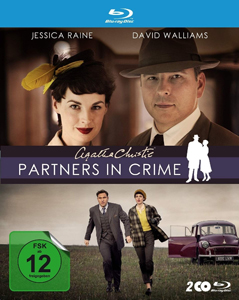
6. “Partners in Crime” (2015)
BBC One/Acorn, six episodes, adapting “The Secret Adversary” and “N or M?”
This is the only series that didn’t get to play out its full vision, or close to it. It adapts two Tommy and Tuppence novels – moving the action from the 1920s and ’40s into the Cold War ’50s — then intends to lead into adaptations of the “Partners in Crime” short story collection, but the show was canceled. David Walliams sleepily plays Tommy and Jessica Raine cautiously plays Tuppence. Oddly, the actors are at a disadvantage because they come pre-packaged as a married couple, but several life-or-death situations do ultimately give them a demonstrable bond. Also odd: “Partners” cares more about the spy plots than anything else, and those plots are hard to follow. Some lightly comedic undercover sequences (like Tuppence posing as a typist in order to search a flat) pay off, and the show looks luscious. But with low fidelity and shaky chemistry, this ranks as the weaker of the T&T series.
Best adaptation: “N or M?”
Worst adaptation: “The Secret Adversary”
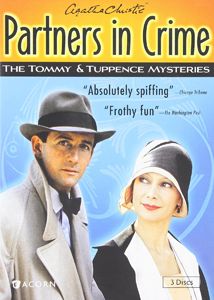
5. “Agatha Christie’s Partners in Crime” (1983-84)
ITV, 10 episodes, adapting the short-story collection “Partners in Crime”
Francesca Annis and James Warwick are by far the highlights thanks to their crackling chemistry as spousal sleuths Tuppence and Tommy Beresford. She’s a little too headstrong, he’s a little too slow on the uptake, but together they are great – not as skilled as Poirot or Marple, but that’s purposeful. The writers are faithful to Christie’s work and by TV necessity add detail to the investigations, which are sometimes truncated in the book. They also emphasize the proto-“Thin Man” banter, but not as much as they could. They never quite get a handle on the comedic possibilities of office helper Albert, although Reece Dinsdale gives it his all as the young man who patterns himself after his cinematic hero of the moment. With a lot of video-shot interiors that hint at a sitcom style, “Partners” suggests it’ll be a laugh-fest but that’s not its goal; maybe it should have been.
Best adaptation: “The Sunningdale Mystery”
Worst adaptation: “The Case of the Missing Lady”
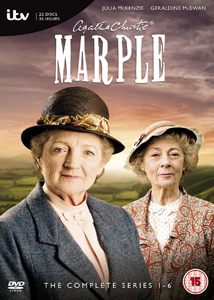
4. “Agatha Christie’s Marple” (2004-13)
ITV, six seasons, 23 episodes, adapting the 12 Miss Marple novels plus two Marple short stories and nine other Christie novels
This production aims to make Marple – rather than Christie’s stories – the star, and that’s sometimes a misfire; it gets particularly dicey when Marple is inserted into nine stories where she was not in the novel. Rather than an observer, she turns into a lurker, which isn’t in character; it also necessitates making the plot more complex since if it stayed as simple as in the novel, Marple would solve it fast.
Geraldine McEwan (Seasons 1-3) has a dark twinkle to her eye, reading Hammett and Chandler (setting the series in the Forties) and seeming to enjoy sending perpetrators to the gallows. Julia McKenzie (Seasons 4-6) is a sprightlier, warmer version. Though there’s no sense of continuity between the two actresses, both fit into the broad definition of Jane. This series is brighter and brisker (90-minute episodes instead of 2-3 hours) than the 1980s version, and less demure about issues such as sexuality. Some plot and character reinventions run off the rails, but on balance this series is more competitive with the 1980s show than its reputation suggests.
Best adaptation: “The Moving Finger”
Worst adaptation: “Murder is Easy”
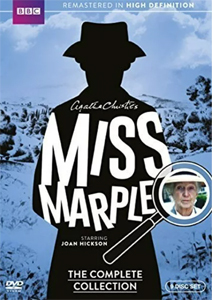
3. “Miss Marple” (1984-92)
BBC One, 12 adaptations over 26 episodes, adapting the 12 Miss Marple novels
As per the 1980s British style, the makers of this show are in absolutely no rush, with 10 adaptations being 2 hours long and two being 3 hours. The series is wry, gray and drafty, but paradoxically rather cozy as we join Jane for a peek into the cases (all moved to the 1950s, and all impeccably designed except for the last couple, when either the budget or the crew’s energy lags). In Joan Hickson’s definitive portrayal of the armchair sleuth, Marple purses her lips, makes silent judgments, and has a twinkle in her eye when she figures it out long before the police inspector. Interestingly, she stays in the background like in the books, with scant bonus screentime from the TV show’s writers. She doesn’t want the spotlight, content to knit while Christie spins the yarn.
Best adaptation: “A Murder is Announced”
Worst adaptation: “They Do It with Mirrors”
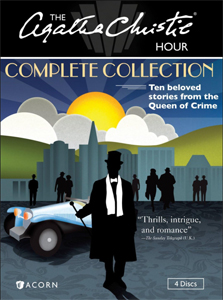
2. “The Agatha Christie Hour” (1982)
ITV, 10 episodes, adapting short stories
Though the early Eighties British adaptations are historically seen as low-stakes proving grounds prior to the Christie estate OK’ing “Miss Marple” and “Poirot,” these 10 screen versions of Mary Westmacott-ish short stories are delightful. The production values have quite a range, but at their high point they are lavish costume dramas that hint at what would come in the 21st century. Collectively, the tales paint a picture of young men and women finding their paths in 1920s Britain. Especially effective on TV is the Parker Pyne premise, wherein the statistician makes calculations of happiness for his clients. Only two Pynes are adapted, but they give us pre-“Poirot” versions of Miss Lemon and Ariadne Oliver.
Best adaptation: “The Case of the Discontented Soldier”
Worst adaptation: “In a Glass Darkly”
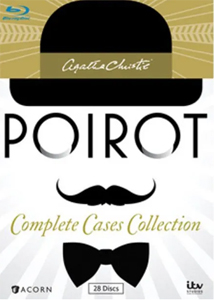
1. “Agatha Christie’s Poirot” (1989-2013)
ITV, 13 seasons, 70 episodes, adapting all 33 Poirot novels and most of the short stories
The crown jewel of Christie adaptations strikes a balance between fidelity to the text and recognition of when it needs to be punched up. The series is split into light (Seasons 1-8) and dark (9-13) halves; this roughly matches the literature, because Christie got tired of Hastings and moved him to Argentina. The light half includes all of the show’s short-story adaptations, and the basic nature of the plots allows for camaraderie among the Whitehaven Four: David Suchet’s jauntier Poirot, Hugh Fraser’s endearingly simple-minded Hastings, Philip Jackson’s meat-and-potatoes Inspector Japp, and – the biggest (but also most delightful) alteration from the text — Pauline Moran’s organized but expressive Miss Lemon.
In the dark half, the production design gets glossy and Poirot gets more into borderline-arrogant moralizing. Although Zoe Wanamaker’s Ariadne is a wonderful friend, Poirot hews closer to his literary edge because his three old besties are absent. In creating their own continuity set mostly in 1936-37 (despite the show lasting a quarter century, Poirot and his black mustache are ageless), the writers make smart choices of what to adapt when. The hits far outnumber the misses as – for better or worse – “Poirot” paves the way for the beautiful-looking but not-always-faithful Christie adaptations since.
Best adaptation: “Five Little Pigs”
Worst adaptation: “Appointment with Death”