
In addition to creating Hercule Poirot and Miss Marple and writing six non-mystery novels under the name Mary Westmacott, Agatha Christie wrote 30 other books. They range from extravagant failures to masterworks with reverberations through the decades in literature, film and TV.
Here are my rankings (with no major spoilers) of the 30 Christie books outside the sphere of Poirot, Marple or Westmacott, along with notes on where you can find the screen adaptations:
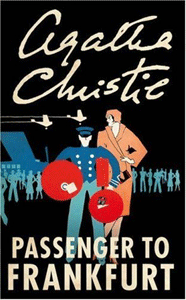
30. “Passenger to Frankfurt” (1970)
Christie’s editors did her no favors during her late-career tape-recorder-dictation phase. She goes a step beyond her usual global romps and tries to make complex political points. Most frustrating to me as a copy editor by trade, she misuses the word “anarchist” throughout the novel, intending to mean revolutionaries who want a new form of government. (Anarchists oppose all governance.) There’s no main character and it’s not even adventurous, often switching to sitting-room discussions. This shouldn’t have been published.
Adaptations: None
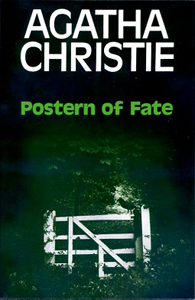
29. “Postern of Fate” (1973)
Tommy & Tuppence No. 5
The last entry in Christie’s unique T&T series, wherein they age in real time from 20s to 70s, is more readable than the lower entry thanks to the Beresfords’ old-married-couple banter. It’s not a well-written mystery, as the author (via Tuppence) spends more time being wistful about yard toys than the guy in “Citizen Kane.” Book nerds might enjoy the opening ramble wherein the septuagenarians aim to organize their sprawling home library.
Adaptations: None
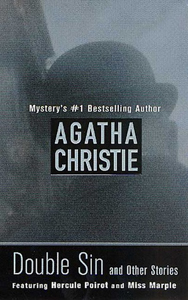
28. “Double Sin and Other Stories” (1961)
There are only two non-Poirot, non-Marple stories in this collection, both horror-leaning. “The Last Séance” is the worst of her supernatural works, feeling pointless. But “The Dressmaker’s Doll” is a fun read, perhaps influential on the now-more-ubiquitous genre of “living doll” stories. The tales are notable for being unambiguously supernatural, which breaks a rule of detective fiction – whether a bug or a perk depends on the reader.
Adaptations: None
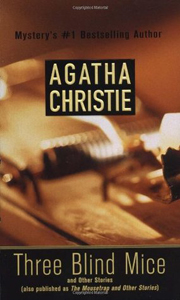
27. “Three Blind Mice and Other Stories” (1950)
Also published as “The Mousetrap and Other Stories”; includes Mr. Quin
This collection includes only two non-Poirot, non-Marples, but they are noteworthy. The title story, a.k.a. “The Mousetrap,” is the prose version of the iconic play that has run for 30,000 performances from 1952 through today (allowing for a COVID break). The contract stipulates that as long as the play is running, the story can’t be published in the UK (not really a problem in the Amazon age) and a screen adaptation can’t be made. As for the story itself, the mood of a snowed-in lodge outstrips the basic mystery. The other entry is “The Love Detectives,” a stray Mr. Quin left out of his 1930 collection, perhaps because it’s so easily solvable.
Adaptations: None, but “See How They Run” (2022) uses “The Mousetrap” play as a backdrop.
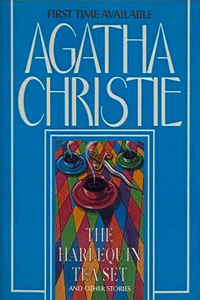
26. “The Harlequin Tea Set” (1997)
Includes Mr. Quin
Not merely dregs, there’s tasty stuff in this pot of eight non-Poirot, non-Marples. A highlight is the title yarn, the last and best tale about Harley Quin, a possibly supernatural being who manipulates romances. The worst, but also the most interesting, is “Manx Gold,” a commissioned piece written in 1930 to launch a newspaper-sponsored treasure hunt on the Isle of Man. The others are non-mystery morality tales that missed the “Golden Ball” cut. I’m fond of “The Lonely God,” a religious debate, and “The Edge,” about truthfulness in a marriage.
Adaptations: None
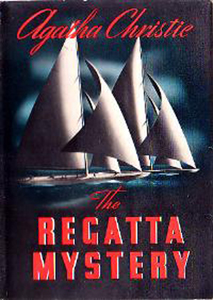
25. “The Regatta Mystery and Other Stories” (1939)
Includes Parker Pyne
This collection includes three non-Poirot, non-Marples. “In a Glass Darkly” is solid fable about a man with external fears who should be looking inward. The other two are Parker Pynes written after his 1934 collection — both taking him out of the office, which he isn’t thrilled with. In “Problem at Pollensa Bay,” Pyne skillfully manipulates a mother into approving of her son’s fiancée. “The Regatta Mystery” finds Pyne solving a jewel theft at a dinner party; I’m not sure why Christie swapped out Poirot, the sleuth in the original magazine printing.
Adaptations: “The Agatha Christie Hour” (1982) adapts “In a Glass Darkly.” The two Pyne stories have not been adapted.
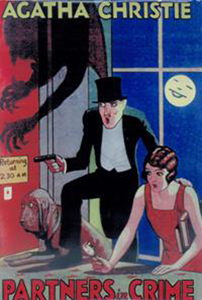
24. “Partners in Crime” (1929)
Tommy & Tuppence No. 2
The couple starts their own agency and works through 13 cases, some of which are good (“The Sunningdale Mystery” is the standout) and some not (“The Unbreakable Alibi”). The concept is sharper than most modern readers (including me) will realize, as each chapter is a parody of a fictional detective of the era. T&T’s banter is a precursor to “The Thin Man”; Hammett writes it better, but Christie got there first. And the idea of Tommy taking the lead because people won’t believe Tuppence can solve mysteries is a precursor to TV’s “Remington Steele.”
Adaptations: “Partners in Crime” (1983-84) adapts 10 stories: “The Affair of the Pink Pearl” (which also incorporates the two introductory chapters), “Finessing the King,” “The House of Lurking Death,” “The Sunningdale Mystery,” “The Clergyman’s Daughter,” “The Ambassador’s Boots,” “The Unbreakable Alibi,” “The Man in the Mist,” “The Case of the Missing Lady” and “The Crackler.” That leaves three unadapted: “The Adventure of the Sinister Stranger,” “Blindman’s Bluff” and the concluding chapter “The Man Who Was No. 16.”
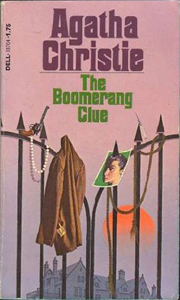
23. “Why Didn’t They Ask Evans?” (1934)
Also published as “The Boomerang Clue”
The team-up of Frankie and Bobby, childhood friends who as adults are aware of being on opposite sides of the tracks, is cute. The mystery isn’t great by Christie’s standards; basically the duo bumbles around and gathers information until the picture is complete. It’s a little frustrating because the dying man at the start had figured it all out and now Frankie and Bobby have to do the same. The culprit and the reason the titular question matters resist staying in my head.
Adaptations: 1980 TV movie, Julia McKenzie’s “Marple” Season 4 episode (2011), 2022 miniseries
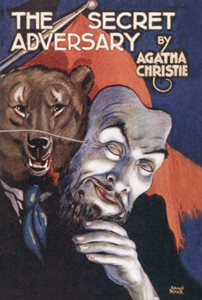
22. “The Secret Adversary” (1922)
Tommy & Tuppence No. 1
When Christie blends romances with mystery-solving, we usually lament that the characters are one-book-and-done. Tommy and Tuppence are the exception; they’d last five books over six decades. This novel marks the 20-somethings’ awkward courtship and awkward solving of their first case. Though “Adversary” says something about the pluck needed to find (or create) your first professional job, the plot isn’t all that engaging. Luckily that’s not the case with the sleuths.
Adaptations: 1983 TV movie, “Partners in Crime” TV series (2015)
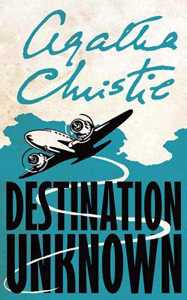
21. “Destination Unknown” (1954)
Also published as “So Many Steps to Death”
This is among Christie’s most different novels – not necessarily good but fascinating for oddity value. Hilary is an unusual heroine: a blank-slate adult, more like a dystopian teen heroine in the vein of Shailene Woodley’s “Divergent” character, gradually learning about the evils of the state. She goes behind an Iron Curtain that Christie is terrified of, and that translates to the reader. The way Hilary’s handlers track her across the globe is insane, and it’s unfortunate that Christie cedes the final POV from the heroine to the handler.
Adaptations: None
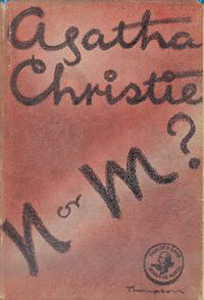
20. “N or M?” (1941)
Tommy & Tuppence No. 3
T&T are the fun-loving, figure-it-out-as-we-go sleuths, but here they must adjust for the grim war, taking jobs as counter-spy agents. In fact, this is the author’s most grounded World War II novel. We absorb her genuine worry that the UK could be conquered by Nazis. The book starts slow and drab, but gains warmth as a piece of evidence must be tracked down in a household. Always challenging herself, Christie endearingly writes a toddler’s communications similar to how she writes the dog’s “speech” in “Dumb Witness.”
Adaptation: “Partners in Crime” TV series (2015)
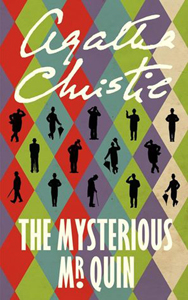
19. “The Mysterious Mr. Quin” (1930)
Don’t come to this 12-story collection for the procedural aspect of mysteries. Rather, Christie – emotionally recovering from her divorce from Archie – is wistful about relationships and uses the borderline-supernatural Harley Quin as her guide. He operates through Mr. Satterthwaite, a bachelor with a knack for getting people to open up. Some stories do include murders to be solved, but on the other hand, “Harlequin’s Lane” is a poetic portrayal of lost and found love.
Adaptation: The lost film “The Passing of Mr. Quin” (1928) adapts “The Coming of Mr. Quin.” G. Roy McRae’s novelization, spelled slightly different as “The Passing of Mr. Quinn,” can be found in a 2018 reprint. No other Quin stories have been adapted.
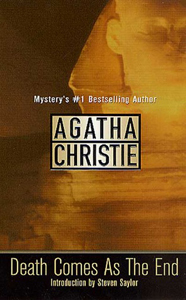
18. “Death Comes as the End” (1944)
I’ve labeled some books on this list as “different,” but nothing can compete with this murder mystery: It’s set in ancient Egypt! Although Christie draws on the archaeological knowledge she acquired as a helper on husband Max Mallowan’s digs, she doesn’t portray the characters in peacetime agricultural Egypt as a strange foreign culture. (As a kindness to the reader, they speak modern English.) I think she purposely makes a point that Egyptian extended families living in a single courtyard are basically the same as 20th century English families chafing under one manor roof.
Adaptations: None
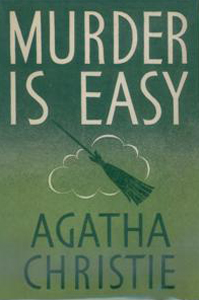
17. “Murder is Easy” (1939)
Also published as “Easy to Kill”; includes Superintendent Battle
Sleuths must consider means, motive and opportunity. In a novel-length thought-experiment of sorts, Christie wonders “What if there is no (apparent) motive? Would it be possible to catch the killer?” Though you can probably guess the answer, the journey is enjoyable as we’re with amateur sleuths Luke and Bridget, whose coupling is not so inevitable, because Bridget is engaged. Though a string of village serial killings is not the most pleasant thing – and the ultimate psychological motive leaves a chill — the book has an incongruous upbeat vibe because nothing is personal to Luke and Bridget.
Adaptations: 1982 movie, 2023 miniseries
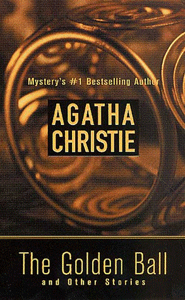
16. “The Golden Ball and Other Stories” (1971)
This is the go-to collection for fans of Christie’s Westmacott novels. All 15 of these short stories from the 1920s and ’30s are standalones. Young men and women are excited and/or trepidatious about jobs and relationships, with a lingering craving for adventure against the staid English backdrop. Though a few tales are melancholy and a few are supernatural, mostly you’ll feel giddy. The title story is typical: George meets a plucky woman who is more in control than she pretends to be, they have an adventure and they fall in love.
Adaptations: “The Agatha Christie Hour” (1982) adapts “The Girl in the Train,” “The Manhood of Edward Robinson,” “Jane in Search of a Job” and “Magnolia Blossom.” The other 11 have not been adapted.
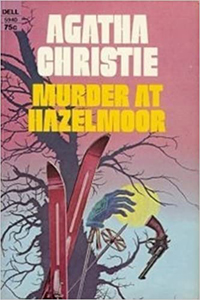
15. “The Sittaford Mystery” (1931)
Also published as “The Murder at Hazelmoor”
This is a wintry mood piece as people play a Ouija-style game at a lodge atop a hill in a blizzard. The game prophesizes someone’s murder in the village three miles below. Christie smoothly uses Sayers-style timing to pull this one off. She spices it up with a wide cast of suspects, although a dramatis personae is necessary to keep track of the majors and captains and inspectors and constables. For a change of pace, amateurs Emily and Charles are merely partners in sleuthing, not in romance, creating a harsh edge to the way she uses him.
Adaptation: Geraldine McEwan’s “Marple” Season 2 episode (2006)
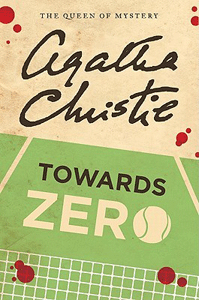
14. “Towards Zero” (1944)
Includes Superintendent Battle
It has the standard manor-full-of-suspects setting but an infusion of atmosphere as the house is isolated, situated across a frothing September bay from the beach town. Christie plays with structure, as the narrator reminds us that murder stories start well before the murder. So everyone simmers in the house – including three members of a particularly contentious love triangle centered on a former tennis star – and we are directed to think about who might be the victim as well as who might be the killer.
Adaptations: “Innocent Lies” (1995), McEwan’s “Marple” Season 3 episode (2008), 2025 miniseries
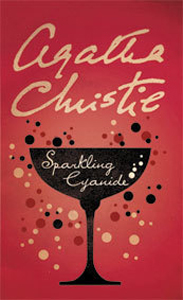
13. “Sparkling Cyanide” (1945)
Also published as “Remembered Death”; includes Colonel Race
In the 1930s, Christie proved her plotting skills, and in the 1940s she added more emotion and character. “Cyanide” is a prime vintage of the two disciplines as the first section reflects on the life of the initial victim, Rosemary, then the same deadly scenario seems to be playing out for a potential second victim. Christie swaps out Poirot from the short story “Yellow Iris” for Race, perhaps deciding this is a solvable procedural. Still, it’s clever how the logistics of a round table play into the climactic scene at a club.
Adaptations: 1983 TV movie, 2003 TV movie
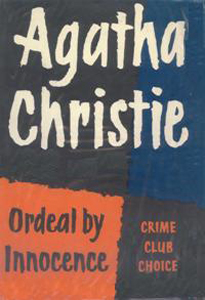
12. “Ordeal by Innocence” (1958)
In what Christie ranked as one of her top achievements, she explores the psychological toll on the innocent when a murder goes unsolved. It’s great for the murderer, who gets off scot-free, but the others must go through life as suspected killers. The Argyles are a searingly dysfunctional family, with the matriarch professing a bizarre and tragic disconnect toward her adopted children, so it’s appropriate that there’s little humor to go with the dark theme. We feel a sense of responsibility to find the truth along with POV character Arthur Calgary, who is the alibi for a convicted man – but he couldn’t present that alibi because he was out of contact for two years.
Adaptations: 1984 movie, McEwan’s “Marple” Season 3 episode (2007), 2018 miniseries
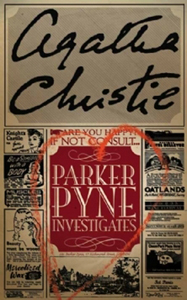
11. “Parker Pyne Investigates” (1934)
Also published as “Mr. Parker Pyne, Detective”; includes Ariadne Oliver
Pyne doesn’t get talked about much, but he’s a pretty great invention, perhaps a fleshing out of Doyle’s Mycroft Holmes. A “detective of the heart,” he shrewdly operates in the style of a con man, but for people instead of against them. His agency sets up events to bring happiness to people. This can function like matchmaking or marriage counseling, but it can involve contentment in any area of life. Twelve of Pynes’ 14 stories appear here, and continuity nerds will be happy to see the first appearances of secretary Miss Lemon (later to work for Poirot) and author Ariadne Oliver (later Poirot’s friend).
Adaptations: “The Agatha Christie Hour” (1982) adapts “The Case of the Middle-aged Wife” and “The Case of the Discontented Soldier.” The other 10 stories have not been adapted.
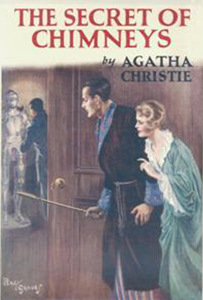
10. “The Secret of Chimneys” (1925)
Bundle Brent No. 1, includes Superintendent Battle
The first of the Bundle duology finds the teen nearly lost in a bevy of colorful characters. The main character for a while is Anthony Cade, who pretends to be Jimmy McGrath. Then it’s Virginia Revel, who buys a packet of important papers just for the sake of getting wrapped up in intrigue. It’s not all goofiness, as at one point we get Christie’s sober defense of monarchy — the argument being that humans aren’t mature enough for democracy. Scholars have pointed out that “Chimneys” and its sequel are parodies of adventure novels of the day, something lost to time. But I contend that Christie’s flavor of silly fun does stand the test of time.
Adaptation: McKenzie’s “Marple” Season 5 episode (2010)
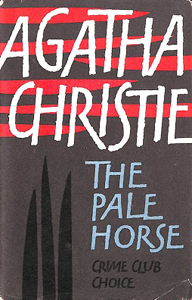
9. “The Pale Horse” (1961)
Includes Ariadne Oliver
Christie successfully casts a witchy spell. We know people aren’t really dying due to curses from a trio of magic-users at the titular hotel. Or do we? On top of that, the grounded mystery is good, as a priest finds a list of names; it’s meaningless until the people start dying. Christie hands off the point of view a few times and we settle on Mark Easterbrook, who teams up with Ginger in one of those amateur-sleuth love matches – this one weightier because he rejects Hermia for the new girl. Ironically for a book that hints at the supernatural, it’s a bizarre but real poison that makes it famous.
Adaptations: 1997 TV movie, McKenzie’s “Marple” Season 5 episode (2010), 2020 miniseries
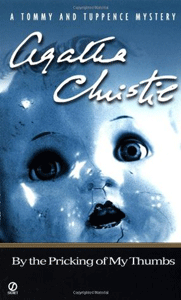
8. “By the Pricking of My Thumbs” (1968)
Tommy & Tuppence No. 4
Liking T&T’s personalities and interplay more so than their books, I longed for a great one, and “Thumbs” delivers. Christie’s Sixties tendency to overwrite – due to dictation and not much editing – actually pairs well with Tuppence, who is in her 60s. She has lost a step, but she’s still got game. She is compelled to pursue a vague suggestion that a child might have been buried in a wall behind a fireplace, and stumbles from point to point (even driving around aimlessly for a while), but with forward progress. Naturally, she ropes in her loyal but not-entirely-thrilled husband.
Adaptation: McEwan’s “Marple” Season 2 (2006)
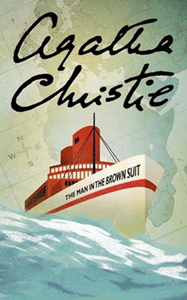
7. “The Man in the Brown Suit” (1924)
Includes Colonel Race
Christie created great series characters, but we’re left to lament the great one-and-done heroines. The earliest is Anne Beddingfeld, given a thorough backstory as a poor orphan with a wide-eyed sense of adventure; she can’t resist hopping aboard a cruise to solve a murder she had witnessed in London. Christie draws on her own vacation along the Indian Ocean coast with various stops on the Dark Continent before reaching South Africa, on the cusp of independence from Britain. The liveliness of the sights matches the personality of Anne, who befriends an upper-class lady and is smitten with the title character, even though he’s a suspect. The mystery gets overshadowed, but that’s OK.
Adaptation: 1989 TV movie
6. “They Came to Baghdad” (1951)
This is Christie’s elite globe-spanning thriller matching the forces of freedom against the forces of Communism. It’s driven by Victoria Jones, who desires adventure just for something to do, but contrasting “Destination Unknown’s” Hilary, she is exuberant rather than depressive. We like her right off the bat when she gets fired as a typist for making fun of her boss. Christie presents Iraq as thriving, an eye-opening time capsule for 21st century readers who know it as a hotspot of the USA’s War on Terror. She crisply expresses her somewhat-Pollyana political view as someone who supports a community of nations devoted to peace.
Adaptations: None
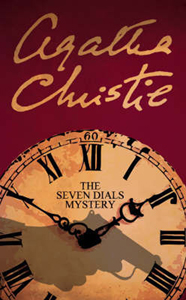
5. “The Seven Dials Mystery” (1929)
Bundle Brent No. 2, includes Superintendent Battle
This could serve as the next step for youngsters moving up from “Hardy Boys” and “Nancy Drew,” and it continues that vibe from “Chimneys” that played as a dime-store parody in the 1920s and today reads as flighty fun. Now in her 20s, Bundle is the core character among a group of scalawags who prank a friend with seven alarm clocks, but he turns up dead. Investigations by Bundle and her in-over-their-heads friends lead to a secret society, but all is not as it seems. Of all the shortchanged leads in the Christie canon, Bundle is the one I most lament not getting more stories.
Adaptations: 1981 TV movie, 2026 miniseries
4. “The Witness for the Prosecution and Other Stories” (1948)
The GOAT of the short-story collections is highlighted by the title story, a gripping courtroom drama with an iconic final line. That one is timeless, whereas “Philomel Cottage” is of its time but stands as a core tale of a woman who finds herself trapped in a marriage to a man who has changed; the entirety of Lifetime’s catalog springs from this yarn. The best of the rest is “The Fourth Man,” a compelling tale of supernatural possession told in a train compartment.
Adaptations: “Witness for the Prosecution” has a 1957 movie, 1982 movie and 2016 miniseries. “Philomel Cottage” has two movies: “A Night of Terror” (a.k.a. “Love from a Stranger,” 1937) and “Love from a Stranger” (1947). “The Agatha Christie Hour” (1982) adapts “The Fourth Man,” “The Mystery of the Blue Jar” and “The Red Signal.”
3. “Crooked House” (1949)
Famous (or infamous) in that Christie “goes there” with the conclusion, “House” earns it with subtle clues and characterization amid a particularly contentious family country mansion. It’s the most bone-chilling of her 1940s character-driven mysteries as it explores nature versus nurture and the condition of sociopathy. Told via a one-off amateur sleuth courting one of the Leonides daughters, this is a strong, straight-ahead murder mystery on the first read and a complete psychological character profile on the second.
Adaptation: 2017 movie
2. “And Then There Were None” (1939)
Also published as “Ten Little Indians”
Christie knew she had something with the ingeniously simple structure of 10 people picked off one by one on an isolated island; she spent more time on this novel than most, making sure the logistics line up to explain how a killer could pull off this trick. It’s her most spine-tingling “nursery rhyme” novel, as each of these guests of U.N. Owen has done something bad in their past and skirted the law. It’s a proto-slasher four decades before “Halloween,” although everyone is dispatched in a polite, off-page manner here.
Adaptations: “And Then There Were None” (1945), “Ten Little Indians” (1959 TV movie), “Ten Little Indians” (1965), “Ten Little Indians” (a.k.a. “And Then There Were None,” 1974), “Ten Little Indians” (1989), “Mindhunters” (2004), “And Then There Were None” (2015 miniseries)
1. “Endless Night” (1967)
Christie lost a step in the Sixties, but inexplicably, she also wrote her very best novel. It’s almost a Westmacott – indeed, the editor asked her to add a mid-book killing to assure the reader – as we get to know first-person narrator Mike. He builds toward his “happily ever after” with adoring wife Ellie, new riches and a state-of-the-art country house designed by his architect friend. However, the mood is uneasy thanks to a witch-like woman reminding them that Gipsy’s Acre is cursed, plus the mantra-like poem about how “some are born to sweet delight” but others to “endless night.” The ending of this masterpiece will stick with you through the night and then some.
Adaptations: 1972 movie, McKenzie’s “Marple” Season 6 episode (2013)