
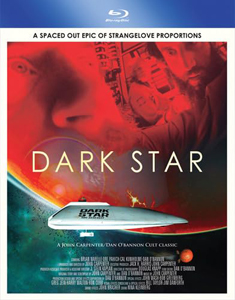
We might not know about “Dark Star” (1974) – let alone be able to easily stream it – if it didn’t happen to have been made by John Carpenter (writer-director) and Dan O’Bannon (writer). They made names for themselves with “Halloween” and “Alien,” respectively, before decade’s end. Carpenter in particular became a legend in sci-fi, horror and – to a lesser extent – the dark comedy featured here.
Initially a student film that the students smuggled from the University of Southern California, “Dark Star” is (or seems) influential for a film most people didn’t see upon its limited release. It features the lightspeed visual effect made famous in “Star Wars” (1977) and broadly has the plot of “Alien” (1979). No surprise in the latter case, as O’Bannon co-wrote “Alien.”
Film scholars often state that “Star Wars” popularized the idea of a “used universe,” a lived-in future, but “Dark Star” precedes it by three years. Carpenter and O’Bannon directly react to the gloss and polish of, in particular, “2001: A Space Odyssey.” (1968). The four astronauts of Dark Star – whose mission is to blow up unstable planets (a direct contrast to the noble search for knowledge in the Kubrick/Clarke film and TV’s “Star Trek” from the late Sixties) – are bearded and somewhat stuck in an extended adolescence.
“Dark Star” (1974)
Director: John Carpenter
Writers: John Carpenter, Dan O’Bannon
Stars: Dan O’Bannon, Dre Pahich, Brian Narelle
While it’s plausible that they rose through the government’s astronaut program, this ship is not a well-oiled machine. It’s partially the fault of four men losing their minds in deep space (one forgets his own first name), partially the fault of a fallible human-built and bureaucratically designed ship. Carpenter and O’Bannon preview Crichton’s chaos theory – complex systems will go awry, no matter how high-tech – and borrow from PKD via an “Ubik”-esque conversation with a deceased captain who persists in a cryo-frozen half-life.
The future is as stupid as the present
The filmmakers don’t parody a specific film or narrative structure, in the style Mel Brooks pioneered in this same year with “Blazing Saddles” and “Young Frankenstein,” but they broadly poke fun at “2001” with a soothing-voiced computer that is helpless as soon as the most minor thing goes awry. The female-voiced Dark Star computer and a male-voiced bomb argue in a manner of the airport-announcement voices in “Airplane!” (1980).
“Dark Star” would’ve been better if it more directly used “2001’s” plot. Its meandering nature pushes it too close to boring for a lot of its 83 minutes (expanded from its original 45). It perks up with its most blunt gags, like when an astronaut attempts to talk down a bomb from blowing up. He uses the distraction of big philosophical questions about the nature of existence. Some one-liners are funny (the half-alive captain asks how the Dodgers are doing) but not delivered with zing.
It’s notable that when Brooks parodied sci-fi in “Spaceballs,” he directly targeted “Star Wars” and threw in other adventurous soft-SF. “Dark Star” goes after thoughtful hard-SF, and that’s harder to get laughs out of. When I watch visions of a utopian future, I go along with it because I’m in the spirit of what could be. I don’t believe it’s plausible, so when “Dark Star” says “Here’s what would actually happen,” that’s not a hilarious revelation in and of itself.
“Dark Star” is not dumb, but it’s impressed with itself before it convinces the viewer. It’s a great semi-student film but not so great without that asterisk. Perhaps it taught Carpenter that less-direct commentary has more impact and taught O’Bannon that true scares are more entertaining than joke-scares (this film uses a beach-ball E.T., basically an irksome pet). Watching “Dark Star” feels like returning to the classroom.