
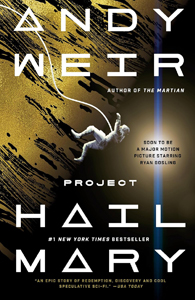
Andy Weir continues to make a case that he’s the Arthur C. Clarke of the 21st century with his third book, “Project Hail Mary” (2021). On this book and “The Martian” (likewise made into a hit movie, and which enabled him to quit his software engineer job and be a full-time author), he strikes me as a science-based imagineer who uses books as a necessary tool of communication.
“PHM” is all about science challenges that first-person protagonist Ryland Grace (who I think of as being Weir) must solve as he journeys from Earth to Tau Ceti to learn why that sun is immune to Astrophage (which is eating Earth’s sun).
It’s to Weir’s credit that I as a layperson understand the science puzzles and solutions, and that they don’t get boring even though the book’s structure is repetitive. He invents just a few sci-fi conveniences – namely the amazing structural metal xenonite – to expand the possible solutions.

“Project Hail Mary” (2021)
Author: Andy Weir
Genre: Hard sci-fi
Setting: Near future, Earth and Tau Ceti system
Xenonite comes from Rocky, his new friend who is a five-legged spider-rock from Eridia. The Ryland-Rocky friendship is the book’s heart. I like the challenge-solution of their communications even more than the hard space science. Rocky’s language is based on music notes, and the new friends steadily work up translations of key words.
It’s satisfying to see their dictionaries get built up. Even though Rocky’s English is in pidgin form, he’s a genius in some categories of science. They communicate smoothly and cutely, creating some of their own workarounds for subtleties of language – for example repeating a word three times to indicate emphasis (like “happy happy happy” and “bad bad bad”).
Intergalactic friendship adds heart to hard sci-fi
The adult-style Elliot-and-E.T. provides all the feeling. Only after closing the novel do I realize Weir skips over some emotional issues. Ryland – who knows the trip is one-way — briefly notes that he’s not particularly social. But “PHM” never mentions his mom or dad. Though he’s a schoolteacher and nominally loves his students like they were his own children, we’re shown no individual close relationships.
Weir gets away with what could be an extreme oversight due to a creative structure. The narrative is told over two alternating timelines. In present day, we follow his mission to Tau Ceti. In flashbacks, we follow Earth’s discovery of the sun plague and the buildup to the space mission.
Cleverly, Weir dodges roteness to the past story because present-day Ryland has amnesia he’s slowly recovering from. When we learn something in a flashback segment, that memory is simultaneously returning to Ryland.
So “Project Hail Mary” – which includes only cursory commentary about the state of the Earth (in climate and global relations) as occupied by humans — is wholly about creative problem solving, as if intractable problems are too boring to discuss. Though Ryland and Rocky go through ups and downs, Weir’s tone tips his hand that we’re building to a happy ending of some kind. And that’s as it should be.

The novel: 4 stars
THE MOVIE
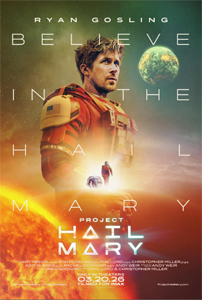
The film adaptation of “Project Hail Mary” is a throwback crowd-pleaser, mostly faithful to the novel, but I find it less gripping than the previous collaboration between a Weir novel and a Drew Goddard screenplay, “The Martian” (2015).
As directed by Phil Lord and Christopher Miller, “PHM” de-emphasizes the science puzzles. I doubt someone who didn’t read the book would understand the details, and maybe they wouldn’t even get the broad picture of Grace (Ryan Gosling, “First Man”) going to another galaxy to find a way to save Earth.
At the same time, the film embraces the 21st century idea of fidelity to the source material, so areas that scream out for cinematic buildup – such as having a more robust supporting cast with more human connections – are not built up. Most wasted is Milana Vayntrub as Russian astronaut Olesya; in one brief scene she has an energy on par with Florence Pugh in the MCU films.
“Project Hail Mary” (2026)
Directors: Phil Lord, Christopher Miller
Writers: Drew Goddard (screenplay), Andy Weir (novel)
Stars: Ryan Gosling, Sandra Hüller, James Ortiz
Unlike in “2001” and “Planet of the Apes” – two April 3, 1968 films that feature astronauts who don’t survive hyper-sleep – Grace’s ill-fated colleagues do become people with names and personalities. But the flashbacks aren’t enough to make us feel much about their fates.
A movie star and his alien
In old-school fashion, the nerd is played by one of today’s sexiest movie stars. They mess up Gosling’s hair and give him unsexy glasses to make him a nerd. He has good chemistry with Rocky (voiced by James Ortiz, and keeping some of the book’s cutesy pidgin English). The faceless alien creature is either an animatronic or appears to be, and that’s a winning choice.
Another lead – though far behind Gosling and Rocky — is Sandra Hüller as Stratt, the inter-governmental leader of the world-saving space mission. She plays it cold, as per the book, but adds a resigned tone. Still, like the book, the film doesn’t grapple with the inherent wrongness of the mission’s militant anti-individualism, other than to sort of joke about it. I can’t think of a “save the Earth” movie where I’ve cared less about the Earth.
“Project Hail Mary” makes the problem superficially bigger than “The Martian’s” but – because Grace’s “science-ing the s***” out of things happens in the margins – we are forced to think more about the socio-political side. This film shows the human race solving a huge problem but never convinces me it could in real life. Despite the trump-card cuteness of “Movie Star and His Alien,” it lands as a flat fantasy.
IMDb top 250 trivia
- “Project Hail Mary” ranks at No. 139 on the list with an 8.2 rating, absurdly ahead of (for now) “The Martian’s” 8.0.
- Goddard wrote for a top 250 TV show, “Daredevil” (No. 144, 8.6).
- The highest-rated piece of pseudo-hard-SF on the list is “Interstellar” (No. 17, 8.7).
The movie: 2.5 stars