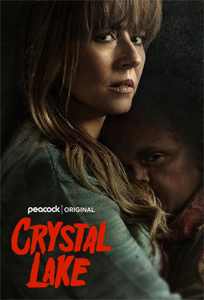
Looking over my reviews of the 12 “Friday the 13th” films, I gave positive ratings to only half of them. But I’m still intrigued by the mythology, and not merely because it’s one of the major horror franchises. The idea that the prequel series “Crystal Lake” (eight episodes, Peacock) would expand it intrigued me.
Creator Brad Caleb Kane and uber-producer Bryan Fuller (who later fully handed off the reins) had a weird task. Almost inevitably, “Crystal Lake” wouldn’t be schlocky; it’s a prestige streaming series with a skilled lead actress – Linda Cardellini as Pamela Voorhees. It couldn’t be a slasher in the film sense (wherein casts of victims are replenished each go-around), because it’s an origin TV series. We naturally expect several main characters to last through most or all of the episodes.
Kane successfully pulls off the trick, and in the finale we learn he pulled off another one: Though it’s not necessary for the satisfaction factor of Season 1, there are enough loose threads to make up a Season 2.
“Crystal Lake” (2026)
Eight episodes, Peacock
Showrunner: Brad Caleb Kane
Stars: Linda Cardellini, William Catlett, Callum Vinson
You might say he’s doing “Cobra Kai” in reverse. Being a prequel rather than a sequel, there’s less freedom. And he doesn’t have access to returning actors; instead he has to re-cast 1972 versions of the 1980 people.
Cardellini is the only name actor (and admittedly she does not closely resemble Betsy Palmer, but her attitude matches) until Hamish Linklater comes in later. Yet the cast of “Crystal Lake” is incredible. Most impressive is Nick Cordileone as Ralph, the “crazy” woodsman who warns of “Camp Blood.” He looks similar to Walt Gorney and nails the vocal inflection. Also of note for resemblance to the OG actors are Cameron Scoggins as cop Dorf, Brian J. Carter as camp operator John Christy, and Danielle Kotch and Phoenix Parnevik as camp counselors Claudette and Barry.
A new local hero
Breaking out here are William Catlett as the Town of Crystal Lake police chief — he was born to play a 1970s grindhouse cop – and Gwendolyn Sundstrom as Grace, Jason’s only friend (aww). Amazing prosthetic work turns Callum Vinson into the young Jason, with an enlarged head that one of those reshaping helmets would be helpless against.
Kane wisely chooses to make “Crystal Lake” into a psychological drama of how initially good-hearted Pamela and Jason become killers, a superhuman killer in the latter case. But he also delivers one treat per episode for gorehounds in the form of a deserving person being on the facially ravaged end of a kill.
“Crystal Lake” has slickly reproduced visuals with intelligent storytelling. But because it embraces grindhouse shlock, both in the Bellflower program that experiments on Jason and in set pieces such as a police-station gun standoff, it feels of a piece with the “Friday the 13th” films’ cheapness.
Granted, it can never feel quite that tossed-together. Each movie’s existence relied on the previous movie’s box office, whereas here all eight episodes were guaranteed. Though there’s a definite through-line, Kane and his team recapture the throw-it-at-the-wall fun of “Friday the 13th” at its high points.
Every actor plays it straight. Pam’s love of Jason is deeply felt and her desire to be a mother to Grace is wonderfully real with a creepy undercurrent because she killed Grace’s mother. But I think the extreme gore (in addition to having intrinsic appeal) adds absurdity that balances the scales. Just as “Friday the 13th” is a reversed and shallower “Psycho,” “Crystal Lake” is a reversed and shallower “Bates Motel.”
Deepest entry in the franchise
The show’s ability to be exactly what it should be – the story of killers who we like because they are killing people who deserve it (in a fictional sense) — is half of its appeal. The other half is that it finds room for genuine questions that lead to discussion and anticipation (both within an episode and when waiting for the next).
On a micro scale, episode two deftly puts a Chekhov’s bowling ball in reach of Pam but then reverses course with a surprise fate for a self-help speaker who falls afoul of our heroine. On a macro scale, episode six ends with Pam’s promise to tell the police chief her full experience with the Argonaut project, then episode seven opens that package.
“Crystal Lake’s” retcon of the timeline – Jason’s drowning happens in 1971 instead of 1958 – allows for the use of Cardellini through all the 1970s events rather than having to seek multiple actresses. (That said, the late 1950s Cardellini in episode seven looks younger; it’s amazing how smoothly that de-aging tech works nowadays. But perhaps it’d be too expensive to use it on more than one episode.)
Another advantage is that the Mad Science part of the story can use the horror aesthetic of the Sixties, and the slasher part of the story can use the horror aesthetic of the Seventies. This was the time of proto-slashers like “The Texas Chain Saw Massacre,” “Black Christmas” and giallos, leading up to the proper slasher breakout “Halloween” (1978) – the point at which a film has enough slashings that we say “OK, this is the start of the slasher era.”
“Crystal Lake,” with one kill per episode amid a wider mystery (albeit an inverted mystery rather than a whodunit), is of the proto-slasher form. I’m not a big fan of retcons, but it’s clear Kane devised this one with thought toward both style and casting. And – though it’s fair to say the bar was not terribly high – he ends up crafting the very best installment of the “Friday the 13th” franchise. His trick results in a treat.